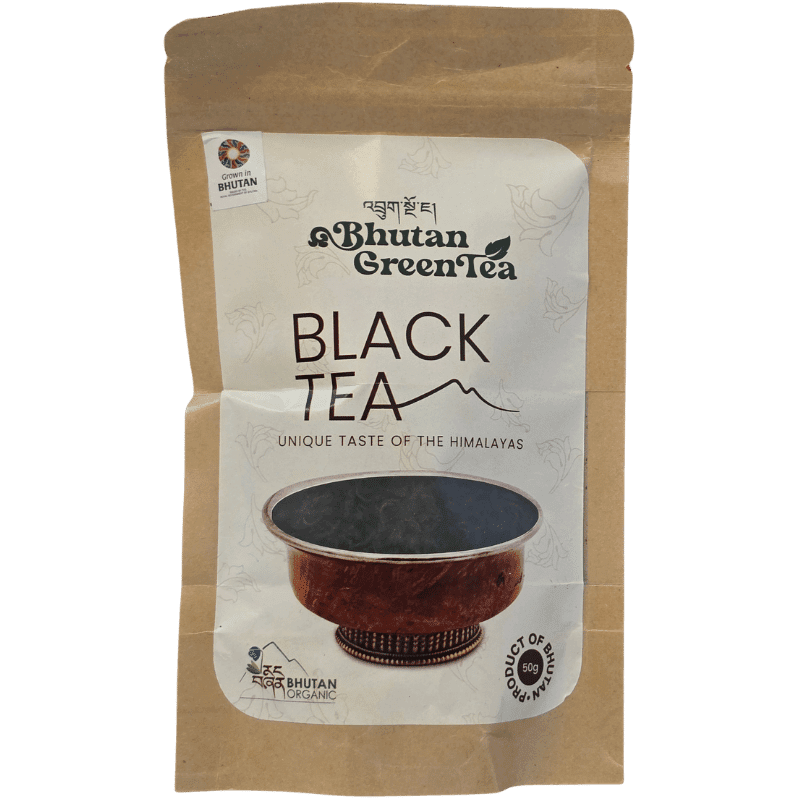
Bhutanese Black Tea (50g)

Full-bodied Himalayan black tea from the misted gardens of Samdrupcholing village in Trongsa, certified organic and traditionally withered.

Bhutanese Black Tea from Samdrupcholing Village

Grown on the eastern slopes of the Trongsa valley, this is a fully-oxidised Himalayan black tea with the deep, honeyed character that comes from cool mountain nights and mineral-rich soil. The leaves are carefully withered, rolled, and oxidised by hand at the village cooperative, then slow-dried over wood fires to preserve the aroma that has made Samdrupcholing a quiet legend among connoisseurs of fine Himalayan teas.

The liquor is a rich amber with a malty, slightly cocoa-like body and a clean, brisk finish. There is no astringency, only the soft sweetness of ripe orchard fruit and a whisper of Himalayan wildflower honey. Drink it black to appreciate its complexity, or take it with a little milk and a touch of sugar in the British hill-station style favoured by the Bhutanese aristocracy.

How to enjoy this heirloom tea in Bangkok:

  • The Traditional Bhutanese Way: Brew strong in a small pot, pour into a cup, and serve alongside Suja (butter tea, made from our Zang Ja) and a plate of zow (puffed red rice). The malty depth of this black tea balances the salt and richness of the butter tea beautifully.
  • The Bangkok Twist: Use it as the base for an iced Thai milk tea with condensed milk. Its robust body stands up to ice and sweetness without becoming bitter.
  • The Modern Way: Cold-brew overnight in the refrigerator for a smooth, low-tannin iced tea that is refreshing on a hot Bangkok afternoon.

Crafted by Bhutan Green Tea, the producer cooperative of Samdrupcholing Zangja Tshongley Detshen in Trongsa, this tea carries LOAS, BFDA-GHP/GMP and Bhutan Organic certification. Every purchase sustains a small mountain village whose tea gardens have been tended by the same families for generations.

Net Weight: 50g

Order through Line

History of Bhutanese Black Tea (50g)

The story of Bhutanese black tea begins in the misted gardens of Samdrupcholing village, perched high in the Trongsa district of central Bhutan. The village sits on a saddle of mountain ridges where the Mangde River cuts through the Himalayas, and its terraced tea gardens are among the highest in the country. Tea was first planted here in the 1960s, at the personal encouragement of His Majesty Jigme Wangchuck, the Second King of Bhutan, who believed the cool climate and mineral soils of Trongsa could produce teas of exceptional quality.

Since then, the village has remained home to the Samdrupcholing Zangja Tshongley Detshen, a farmer-owned cooperative that grows, processes, and markets its own tea under the Bhutan Green Tea banner. The cooperative handles every step by hand, from plucking to withering to firing, and the village’s name has become synonymous with authentic Himalayan tea among Bhutanese households.

Today the cooperative also produces green, oolong, and butter-tea leaves, all from the same gardens and the same families. Buying this black tea is a direct way to support the smallholder farmers of Samdrupcholing, many of whom are third- and fourth-generation tea growers carrying on a quiet, dignified trade that the Second King first set in motion sixty years ago.

Nutritional Value of Bhutanese Black Tea (50g)

Nutrient

Range

Calories

-

Protein

-

Fat

Carbohydrates

-

Fiber

-

Sodium

-

Dietary Pros:

  • 100% Organic & Single-Origin — certified by LOAS, BFDA-GHP/GMP and Bhutan Organic
  • Hand-Plucked & Hand-Processed — no machinery, no chemical inputs
  • Loose-Leaf Whole Leaf — not a teabag; nothing broken or powdered
  • Vegan & Gluten-Free — suitable for most diets
  • Low in Caffeine — roughly 2.5g per 100g of leaf, lighter than Assam or Ceylon

Nutritional Highlights (per 100g of dry leaf): Catechins 12.71g, polyphenols 4.76%, ascorbic acid 65.05mg. These plant compounds are widely studied for their antioxidant and cellular-protective properties.

Health & Lifestyle Benefits:

  • Rich in Antioxidants: The high catechin and polyphenol content helps neutralise free radicals and supports cellular health.
  • Supports Heart Health: Regular consumption of black tea is associated with healthy blood pressure and improved cholesterol profiles.
  • Gentle on the Stomach: Lower in tannins than many commercial black teas, making it smoother for daily drinking.
  • Mental Clarity: A modest dose of caffeine combined with L-theanine provides steady, alert focus without the jitteriness of coffee.
  • Sustains a Mountain Village: Every purchase directly supports the smallholder farmers of Samdrupcholing in Trongsa, helping a remote Himalayan community preserve its tea heritage.

How to make Bhutanese Black Tea (50g)?

This whole-leaf black tea is forgiving and rewarding. Use one teaspoon of leaves (about 3g) per 250ml cup of water just off the boil (95–98°C).

  1. Rinse and Warm: Pour a little hot water over the leaves, swirl for five seconds, and discard. This awakens the leaves and warms the vessel.
  2. Steep: Add fresh hot water and steep for 3 to 4 minutes for a balanced cup, or up to 5 minutes for a stronger, maltier brew.
  3. Serve: Strain into a cup and enjoy plain, or add a splash of milk and a small spoonful of honey. In Bhutanese homes it is traditionally served alongside Suja and puffed rice (zow).

Brewing Tip: The leaves can be re-steeped two to three times; each infusion reveals a different facet, from malty and rich to floral and honeyed. Store the loose leaves in an airtight tin away from sunlight, spices, and moisture to keep them fresh for up to twelve months.

Secret Link