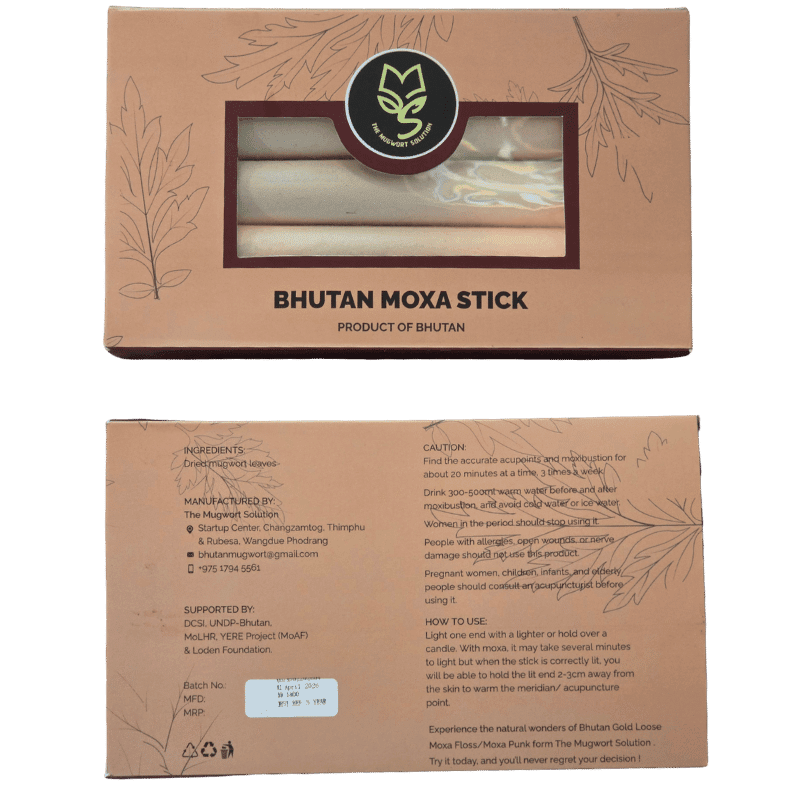
Bhutanese Moxa Stick (TCM)

A traditional moxibustion stick of compressed Himalayan mugwort for at-home warming therapy along the body’s meridians.

Bhutan Moxa Stick — The Warming Therapy of the Himalayas

Moxibustion is one of the oldest and most respected therapies in Traditional Chinese Medicine, with a parallel tradition in Himalayan healing. A moxa stick is a tightly rolled cigar of dried and processed mugwort (Artemisia vulgaris), which is lit and held near the skin to deliver gentle, penetrating warmth to specific points along the body’s meridians. Our moxa stick is made by The Mugwort Solution, a Bhutanese wellness company based in the Startup Center at Changzamtog, Thimphu, with a sister facility in Rubesa, Wangdue Phodrang.

The stick is dense, aromatic, and slow-burning. Lit at one end, it smoulders with a deep, resinous, slightly smoky aroma and produces a steady, gentle heat that can be directed at acupoints, sore muscles, or cold areas of the body. It is widely used by TCM practitioners, acupuncturists, and home users around the world.

How to use this moxa stick in Bangkok:

  • The Traditional Way (Warming Therapy): Light one end of the stick with a lighter or candle until it glows evenly. Hold the lit end 2–3cm from the skin, hovering over the desired acupoint or area. Move the stick slowly in small circular or sweeping motions to deliver gentle, even warmth. Each point is typically warmed for 5 to 15 minutes.
  • For Cold Hands and Feet: Warm the Yongquan point (sole of the foot) and the Laogong point (palm) for 5–10 minutes each. This is a traditional way to bring warmth back to cold extremities.
  • For Sore Muscles: Hover the stick over the sore area, moving it in slow sweeping motions. The heat helps relax tense muscles and encourages circulation.

Supported by DCSI, UNDP-Bhutan, MoLHR, the YERE Project (MoAF), and the Loden Foundation. Shelf life 3 years.

Order through Line

History of Bhutanese Moxa Stick (TCM)

Moxibustion has been practised for at least 2,500 years across China, Japan, Korea, and the Himalayan world. The Chinese character for moxibustion, jiu, refers specifically to the slow smouldering of mugwort over or near the body. The classic text Huangdi Neijing (The Yellow Emperor’s Classic of Medicine), compiled around 200 BCE, describes moxibustion as a therapy for “cold and deficiency” conditions — a framing still used by practitioners today.

In the Himalayan world, moxibustion took slightly different forms. Tibetan medicine integrated it with its own meridian and chakra systems; Bhutanese herbalists adapted it to the local flora, using the abundant highland mugwort as their primary material. It was used in village households as well as in monastic medicine, often in combination with prayers and ritual offerings.

The Mugwort Solution, founded in Bhutan, is a modern expression of this heritage. The company works with highland farmers who cultivate mugwort sustainably, processes the leaves in small batches, and produces moxa sticks that meet contemporary safety and quality standards while honouring the traditional craft.

Nutritional Value of Bhutanese Moxa Stick (TCM)

Nutrient

Range

Calories

-

Protein

-

Fat

Carbohydrates

-

Fiber

-

Sodium

-

Dietary Pros (Product Qualities):

  • 100% Pure Mugwort — dried and processed Artemisia vulgaris leaves
  • Hand-Rolled in Small Batches
  • Slow-Burning & Long-Lasting
  • 3-Year Shelf Life
  • Product of Bhutan

Wellness Benefits:

  • Warms the Body: Moxibustion is traditionally used to “expel cold” and warm areas of chronic coldness or stiffness.
  • Supports Circulation: The gentle radiant heat encourages blood flow to the treated area.
  • Eases Muscle Tension: Warming therapy helps relax sore, tight muscles.
  • Traditional Wisdom: A 2,500-year-old therapy with a parallel Himalayan tradition.
  • Supports Highland Growers: Every purchase supports The Mugwort Solution and the Bhutanese highland farmers who cultivate the mugwort.

Important: Moxibustion is a traditional therapeutic practice. Please consult a qualified TCM practitioner or acupuncturist before use, especially if you are pregnant, have circulation problems, nerve damage, skin sensitivities, or any medical condition. Do not use during menstruation or on open wounds. If irritation occurs, discontinue use.

How to make Bhutanese Moxa Stick (TCM)?

Moxibustion is a focused therapy that rewards patience. Set aside 20–30 minutes for a complete session.

  1. Prepare the Space: Choose a quiet, well-ventilated room. Have a small dish of water or sand nearby to tap off any ash.
  2. Light the Stick: Hold one end of the moxa stick over a candle or lighter flame until it glows evenly red. This usually takes about 30 seconds.
  3. Warm the Point: Hold the lit end 2 to 3 cm from the skin, hovering over the desired acupoint or area. Move it in slow, small circular or sweeping motions to deliver gentle, even warmth.
  4. Duration: Warm each point for 5 to 15 minutes. The skin should feel pleasantly warm, never hot. If it gets too hot, move the stick further away.
  5. Extinguish: Place the stick in a dish of water or sand to fully extinguish. Allow it to dry before storing.

Recommended Protocol: Sessions of about 20 minutes, 3 times per week. Drink 300 to 500 ml of warm water before and after each session.

Cautions: Avoid use during menstruation, on open wounds, areas of nerve damage, or known allergies. Pregnant women, the elderly, and people with serious medical conditions should consult a qualified acupuncturist before use.

Secret Link