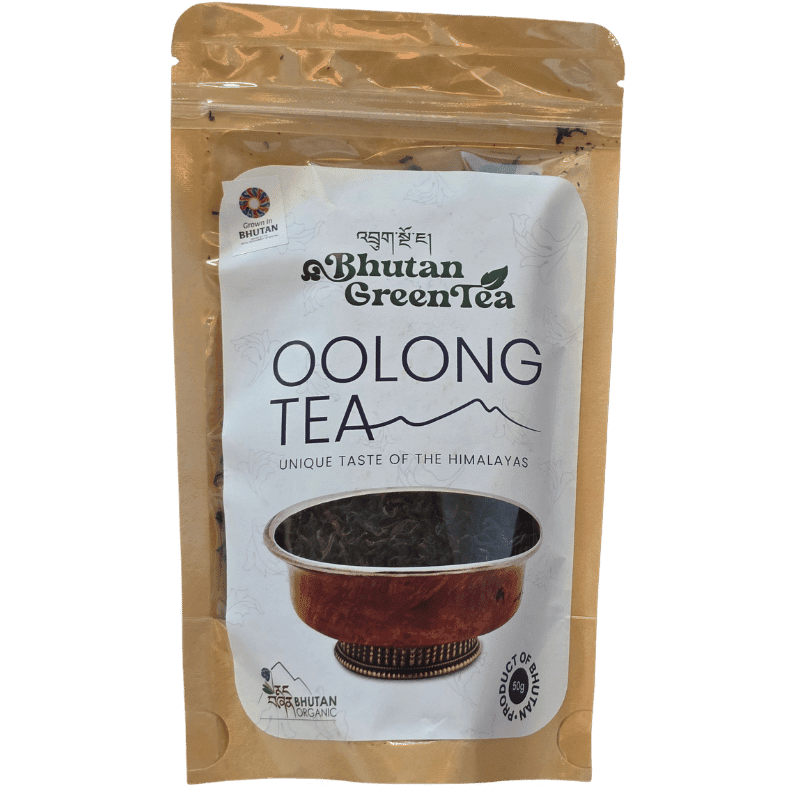
Bhutanese Organic Oolong Tea (50g)

Semi-oxidised Himalayan oolong from Samdrupcholing village, with the roasted, floral complexity of high-mountain terroir.

Bhutanese Oolong Tea from Samdrupcholing

Oolong sits at the crossroads of green and black tea, capturing the fresh florals of one and the warm depth of the other. This lot is grown by the Samdrupcholing Zangja Tshongley Detshen cooperative in Trongsa and processed in the traditional style: withered in the sun, gently bruised to begin oxidation, then fired to lock in a balanced, semi-oxidised character. The result is a complex, layered tea that rewards slow drinking.

The rolled leaves are dark green and tightly twisted; they unfurl gracefully in the cup. The liquor is a glowing amber-orange, with aromas of roasted stone fruit, orchids, and toasted nuts. On the palate it is smooth and rounded, with a long, sweet finish and the mineral signature of the eastern Himalayan foothills.

How to enjoy this Himalayan oolong in Bangkok:

  • The Traditional Way: Use a small clay pot or gaiwan, with 5g of leaves per 100ml of water at 90°C. Steep for 30 seconds, then increase by 10 seconds per infusion.
  • The Quiet Cup: Use one rounded teaspoon per 250ml and steep for 3 minutes in a warmed pot. Re-steep two to three times.
  • Pairing: Serve with grilled meats, roasted nuts, or dried fruits. The tea’s roasted notes complement smoky and savoury dishes.

Crafted under the Bhutan Green Tea banner with LOAS, BFDA-GHP/GMP and Bhutan Organic certification. Buying this oolong sustains the same smallholder families of Samdrupcholing village who grow our black and green teas.

What sets this oolong apart is the careful balance the cooperative strikes between oxidation and heat. Too little and the tea tastes grassy; too much and it loses the high-mountain brightness. The village’s master tea-maker checks the leaves every hour during processing, adjusting the withering beds and the firing temperature to coax out the exact character that Samdrupcholing oolong is quietly becoming known for.

Net Weight: 50g

Order through Line

History of Bhutanese Organic Oolong Tea (50g)

Like the black and green teas of Samdrupcholing, this oolong traces its origins to the 1960s, when His Majesty Jigme Wangchuck, the Second King of Bhutan, encouraged tea cultivation in the cool, mineral-rich valleys of Trongsa. The village cooperative learned over decades to produce not only the everyday black and green teas their grandfathers planted, but also the more demanding semi-oxidised oolong, which requires precise control of withering and oxidation.

The cooperative’s Samdrupcholing Zangja Tshongley Detshen is now one of the few growers in Bhutan producing a true Himalayan oolong. Their small batches are prized by tea merchants in Thimphu and have begun to appear on the menus of specialty tea rooms abroad.

Oolong production in Bhutan remains tiny by global standards, but the high-altitude air, mineral soil, and patient hands of the village’s tea growers give this tea a distinctive profile — brighter than Taiwanese oolongs, deeper than Chinese greens. Every 50g packet is a quiet act of preservation.

Nutritional Value of Bhutanese Organic Oolong Tea (50g)

Nutrient

Range

Calories

-

Protein

-

Fat

Carbohydrates

-

Fiber

-

Sodium

-

Dietary Pros:

  • 100% Organic & Single-Origin — certified by LOAS, BFDA-GHP/GMP and Bhutan Organic
  • Hand-Plucked & Hand-Processed — traditional semi-oxidation
  • Loose-Leaf Whole Leaf — tightly rolled, hand-fired
  • Vegan & Gluten-Free
  • Re-steepable — five to eight infusions per leaf

Nutritional Highlights (per 100g of dry leaf): Catechins 12.71g, polyphenols 4.76%, ascorbic acid 65.05mg. Semi-oxidised oolongs balance the catechin content of green tea with the theaflavins developed during partial oxidation.

Health & Lifestyle Benefits:

  • Rich in Antioxidants: Oolong’s unique combination of catechins and theaflavins supports cellular health.
  • Supports Heart Health: Regular consumption is associated with healthy cholesterol levels.
  • Aids Digestion: Traditional in Chinese and Bhutanese medicine as a digestive aid, especially after fatty meals.
  • Mental Clarity: Caffeine plus L-theanine provide focused, alert energy.
  • Sustains a Mountain Village: Every purchase supports the smallholder tea growers of Samdrupcholing in Trongsa.

How to make Bhutanese Organic Oolong Tea (50g)?

Oolong is a forgiving tea that rewards both gongfu and Western brewing. Use filtered water just off the boil.

  1. Heat the Water: Bring water to 88–92°C. Boiling water will over-extract the leaves and turn them bitter.
  2. Measure: Use 3 to 5 grams per 150–200ml cup, or one rounded teaspoon per 250ml.
  3. Steep: For a Western-style cup, steep for 2 to 3 minutes. For gongfu, start with 30 seconds and increase by 10 seconds for each infusion.
  4. Re-steep: Good oolong yields five to eight infusions, each with a slightly different character.

Tip: Warm your pot or cup first with hot water, then discard the water before adding leaves. This stabilises the brewing temperature and gives the leaves a gentler start.

Secret Link