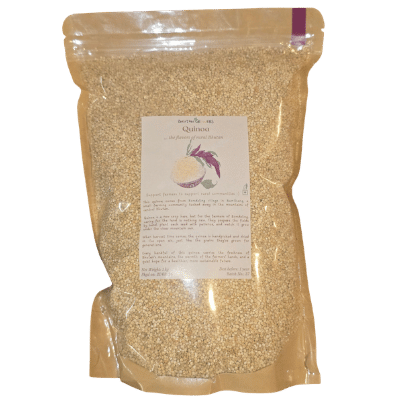
Bhutanese Organic Quinoa (1kg)

Certified organic white quinoa from Bumthang. A plant-based complete protein containing all nine essential amino acids.

Organic Quinoa from Bomdeling Village, Bumthang

Quinoa is a newcomer to Bhutan’s ancient agricultural landscape, but it has already found a perfect home. Introduced in 2015 with support from the Food and Agriculture Organization (FAO), this climate-resilient crop was part of a national initiative to enhance food and nutritional security for the Bhutanese people. The goal was to diversify traditional potato and maize based cropping systems with a versatile, nutrient-dense alternative suited to the country’s mountain environment.

Today, quinoa is cultivated across all 20 districts of Bhutan, including the high valleys of Bumthang, where this particular grain was grown. Our organic white quinoa comes from Bomdeling village in Bumthang, a small farming community tucked away in the mountains of central Bhutan. Quinoa is a new crop here, but for the farmers of Bomdeling, caring for the land is nothing new. They prepare the fields by hand, plant each seed with patience, and watch it grow under the clear mountain sun. When harvest time comes, the quinoa is handpicked and dried in the open air, just like the grains they have grown for generations.

Recognized for its exceptional nutritional value, quinoa has been integrated into Bhutan’s school feeding programs and hospital diets as part of a nationwide effort to address rising cases of non-communicable diseases. A study at the National Referral Hospital in Thimphu found that substituting just 10 percent of rice with quinoa reduced overall rice consumption by 2,000 kilograms.

How to enjoy this versatile supergrain in Bangkok:

  • The Traditional Bhutanese Way: Mix cooked quinoa with Bhutanese Red Rice in a 1:3 ratio to create a nutrient-boosted staple. This method, used in schools and hospitals across Bhutan, helps ease the transition while preserving familiar flavours.
  • The Bangkok Twist: Use quinoa as a base for a spicy Thai salad (yam quinoa). Toss with chopped mint, coriander, lime juice, fish sauce, and finely sliced bird’s eye chilies. Alternatively, substitute it for rice in khao pad (fried rice) for a higher protein version of the classic dish.
  • The Modern Way: Serve as a pilaf with roasted vegetables, add to soups for extra texture, or enjoy as a breakfast porridge with honey and fresh fruit. Its light, fluffy texture and subtle nutty flavour make it an ideal alternative to rice or couscous.

Every handful of this quinoa carries the freshness of Bhutan’s mountains, the warmth of the farmers’ hands, and a quiet hope for a healthier, more sustainable future.

Net Weight: 1kg

Bhutanese Organic Quinoa (1kg) available at Bhutan Kitchen Bangkok

Order through Line

History of Bhutanese Organic Quinoa (1kg)

Quinoa (Chenopodium quinoa) is a flowering plant in the amaranth family, native to the Andean region of South America, where it has been cultivated for thousands of years. Its journey to the Himalayas began in 2015, when the Royal Government of Bhutan, with technical support from the Food and Agriculture Organization (FAO), introduced quinoa as a new crop to enhance food and nutritional security for the Bhutanese people.

The main objective was to adapt this versatile crop to local mountain agriculture conditions as a climate-resilient alternative for diversifying traditional potato and maize based cropping systems. Ten quinoa varieties were evaluated across two different agroecological zones in Bhutan: Yusipang (2600 metres above sea level), representing the cool temperate zone, and Lingmethang (640 metres), representing the dry subtropical zone. The results confirmed that quinoa can be successfully grown in both environments, with grain yields ranging from 0.61 to 2.68 tonnes per hectare in high altitude areas and from 1.59 to 2.98 tonnes per hectare in lower elevations.

By 2018, four varieties had been officially released, and quinoa was rapidly promoted across the country as an alternative food security crop in the 12th Five Year National Development Plan of Bhutan. The Royal Government began supporting rural communities with free quinoa seeds, cultivation technologies, and milling machines. Consumer awareness campaigns were launched, featuring local Bhutanese dishes prepared with quinoa during food fairs and farmers’ field days.

Today, quinoa is grown in an estimated area of 600 acres of land across all 20 Dzongkhags, with the country producing 37.16 metric tonnes in the 2018-2019 season. The first quinoa processing plant was launched in Phuentsholing in 2021, capable of processing 500 kilograms of quinoa per hour, improving the quality of packaged products for both domestic and international markets. In 2025, quinoa was selected as Bhutan’s Special Agricultural Product under the FAO’s One Country One Priority Product (OCOP) initiative, further strengthening efforts to promote sustainable cultivation and market development.

This particular quinoa comes from Bomdeling village in Bumthang, a small farming community in central Bhutan. While Bomdeling is more widely known as the winter habitat of endangered black-necked cranes, the farmers here are now embracing quinoa as a new crop that offers both nutritional and economic promise for their families and their community.

Nutritional Value of Bhutanese Organic Quinoa (1kg)

Nutrient

Range

Calories

368

Protein

14

Fat

6g

Carbohydrates

64g

Fiber

7

Sodium

5

Dietary Pros:

  • Complete plant-based protein containing all nine essential amino acids
  • Naturally gluten-free
  • Low glycemic index
  • High in dietary fibre
  • Rich in iron, magnesium, phosphorus, manganese, and B vitamins
  • Grown without chemical pesticides or fertilisers
  • Non-GMO

Nutritional Excellence:
Quinoa is one of the few plant foods classified as a complete protein due to the presence of all nine essential amino acids that the human body cannot synthesise on its own. One cup of cooked quinoa contains approximately 8 grams of protein, 5 grams of fibre, and only 220 calories. It is also rich in magnesium, potassium, iron, and zinc, and contains beneficial antioxidants that help protect the body from oxidative stress.

Health and Lifestyle Benefits:

  • Heart Health: Quinoa helps lower LDL cholesterol, reduce blood pressure, and prevent heart disease due to its high fibre content and heart-healthy fatty acid profile.
  • Blood Sugar Management: With a low glycemic index, quinoa helps stabilise blood sugar levels, making it particularly beneficial for individuals with diabetes or metabolic disorders.
  • Weight Management: The combination of high protein and high fibre promotes satiety, helping to curb hunger and support healthy weight maintenance.
  • Digestive Health: Quinoa is a rich source of dietary fibre, which promotes a healthy digestive system and regular bowel movements.
  • Muscle Maintenance and Repair: The complete protein profile supports muscle growth, recovery, and maintenance, making quinoa an excellent choice for athletes and active individuals.
  • Supports Rural Farmers: By choosing this quinoa, you directly support smallholder farming communities in Bomdeling village, Bumthang, helping them transition to sustainable, value-added agriculture while preserving traditional farming methods.
  • National Health Initiative: Every purchase supports Bhutan’s national effort to reduce rice consumption and introduce dietary diversity, addressing rising rates of obesity, diabetes, and high blood pressure across the country.

How to make Bhutanese Organic Quinoa (1kg)?

Here are three delicious ways to bring Bhutanese quinoa into your kitchen.

  1. Quinoa and Red Rice Blend (Bhutanese Hospital Style): Rinse 1 cup of Bhutanese Organic Quinoa and 3 cups of Bhutanese Red Rice. Combine in a pot with 6 cups of water (or follow a 2:1 water to grain ratio). Bring to a boil, then reduce heat, cover, and simmer for 15-20 minutes until the water is absorbed. Fluff with a fork. This blend is used in Bhutan’s schools and hospitals to improve nutrition while maintaining the familiar taste of rice. The quinoa adds protein, fibre, and a subtle nutty flavour.
  2. Quinoa Ezay Salad (Bhutanese-Thai Fusion): Cook 1 cup of quinoa according to package instructions and let it cool completely. In a large bowl, combine the quinoa with chopped cucumber, cherry tomatoes, fresh coriander, mint, and finely sliced red onion. For the dressing, whisk together 2 tablespoons of Bhutanese Organic Groundnut Oil, 2 tablespoons of lime juice, 1 tablespoon of fish sauce (or soy sauce for vegetarian), and 1-2 teaspoons of Soya Bean Ezay or Zimtsi Ezay. Toss everything together and serve chilled or at room temperature. The ezay adds a fermented umami depth and a gentle Bhutanese heat.
  3. Quinoa and Mushroom Soup (Himalayan Comfort): Sauté sliced mushrooms, onions, and garlic in a little butter or oil until softened. Add 4 cups of vegetable stock and 1/2 cup of rinsed quinoa. Bring to a boil, then reduce heat and simmer for 15 minutes until the quinoa is tender. Stir in 1/2 cup of coconut milk and 1 teaspoon of Soya Bean Ezay for extra savoury depth. Garnish with fresh herbs and a drizzle of Perilla Oil. The quinoa adds a creamy texture and boosts the soup’s protein content.
Secret Link