
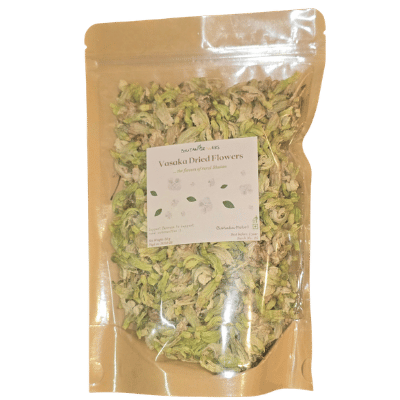
Organic Vasaka Flowers from the southern lowlands of Bhutan
Its name in Dzongkha is Bashika, and its delicate white flowers have been treasured for generations as a natural remedy for the lungs. Known in English as Malabar Nut or Vasaka (Adhatoda vasica), this plant has been used in Bhutanese households for centuries, often collected from the wild to make a therapeutic herbal infusion for coughs, colds, and chest congestion. In a land where winter winds can be harsh, Vasaka flowers have long been a trusted companion.
Bhutanese believe that the bitter flowers have powerful medicinal properties. Modern science confirms this wisdom: the flowers contain potent alkaloids, including vasicine, which act as a natural expectorant and bronchodilator to help clear airways and ease breathing.
How to enjoy Vasaka Flowers:
Each 50g package contains sun-dried whole flowers, harvested from wild stands and organic cultivation in Bhutan’s temperate zones, preserving maximum active compounds. This product is brought to you by Bhutan Growers, supporting sustainable wild harvesting and the preservation of traditional Bhutanese herbal knowledge.
Net Weight: 50g

Vasaka (Adhatoda vasica) , known as Bashika in Dzongkha, is a medicinal shrub that grows wild throughout the Himalayan foothills, from Bhutan and Nepal to India and beyond. In Bhutan, the flowers are often collected from the wild and are considered one of the country’s valuable wild edible plants. A comprehensive survey of edible and wild plants in Bhutan, conducted by the Ministry of Agriculture and Forests in 2012, documented the flower as part of the range of plants used in Bhutanese traditional food and medicine.
The plant has a much deeper history beyond the Himalayas. For over 2,000 years, Vasaka has been a cornerstone of Ayurvedic medicine in India, where it is known as Vasa or Arusha. It is also used in the Unani, Siddha, and Homeopathic systems of medicine. The name Adathoda comes from the Tamil language and means “untouched by goats,” a reference to the plant’s intensely bitter taste, which even animals avoid.
While traditional Indian medicine primarily uses the leaves, it is the flowers that have a special place in Bhutanese households. In many homes, they are boiled to make a bitter tea to soothe coughs and chest congestion, or cooked into a cheese stew for those who appreciate their earthy, medicinal flavour. This product represents that living tradition—a small piece of Bhutan’s indigenous healing heritage, wild-harvested and sun-dried with care.
Dietary Pros:
Active Compounds:
The therapeutic properties of Vasaka flowers and leaves come from a rich profile of bioactive compounds. The most important are the quinazoline alkaloids, primarily vasicine and vasicinone. These compounds are responsible for the plant’s well-documented respiratory benefits. The plant also contains other alkaloids, flavonoids, tannins, and essential oils.
Health and Lifestyle Benefits:
Important Safety Information: Do not use Vasaka flowers during pregnancy or while breastfeeding, as the alkaloids may stimulate uterine muscles. As with any herbal remedy, consult a healthcare provider before regular use, especially if you have underlying health conditions or are taking other medications. Discontinue use if you experience nausea or dizziness.
Here are three traditional and medicinal ways to use Vasaka Flowers.
Please note: Vasaka flowers are a medicinal herb. Consult a healthcare provider before regular use, and avoid during pregnancy.
Traditional Vasaka Herbal Infusion (Respiratory Tonic)
This is the simplest and most common way to use the flowers.
Ingredients: 1-2 teaspoons of dried Vasaka flowers, 200-250ml hot water (near-boiling).
Method: Place the dried flowers in a cup or teapot. Pour the hot water over them and steep for 10-15 minutes. Strain the flowers and drink the liquid. The infusion will have a bitter, earthy taste. If desired, add a small amount of honey to help with palatability. This caffeine-free tea can be enjoyed 1-2 times daily as needed for respiratory support.
Bashika Datshi (Bhutanese Cheese Stew with Vasaka Flowers)
This is a traditional and unique Bhutanese way to eat the flowers, turning them into a savoury dish.
Ingredients: 1 handful of dried Vasaka flowers, 50-70g of local Bhutanese cheese (or a mild feta or cottage cheese), 2-3 dried red chillies (or fresh green chillies to taste), 1 small onion (sliced), 1 clove of garlic (minced), salt to taste, 1 tablespoon vegetable oil.
Method: Rinse the dried flowers and boil them in a pot of water for 5-10 minutes until softened. This also helps to reduce some of the bitterness. Drain the flowers and gently squeeze out the excess water. In a separate pan, heat the oil and sauté the onion, garlic, and chillies. Add the boiled flowers and a splash of water, and simmer for a few minutes. Finally, reduce the heat to low, add the crumbled cheese, and stir gently until it melts into a creamy stew. Do not let it boil. Serve hot with Bhutanese Red Rice.
Vasaka Honey Syrup (Cough Remedy)
A more palatable way to enjoy the respiratory benefits of the flowers, this syrup can be taken by the spoonful or stirred into warm water.
Ingredients: 10g dried Vasaka flowers, 200ml water, 200ml raw honey.
Method: Simmer the dried flowers in water for 15-20 minutes to create a strong decoction. Strain the liquid and discard the flowers. Return the liquid to the pot and simmer until it is reduced by half. Remove from heat and stir in the honey until fully combined. Store the syrup in a clean, sealed jar in the refrigerator. Take 1-2 teaspoons as needed to soothe a cough or scratchy throat.