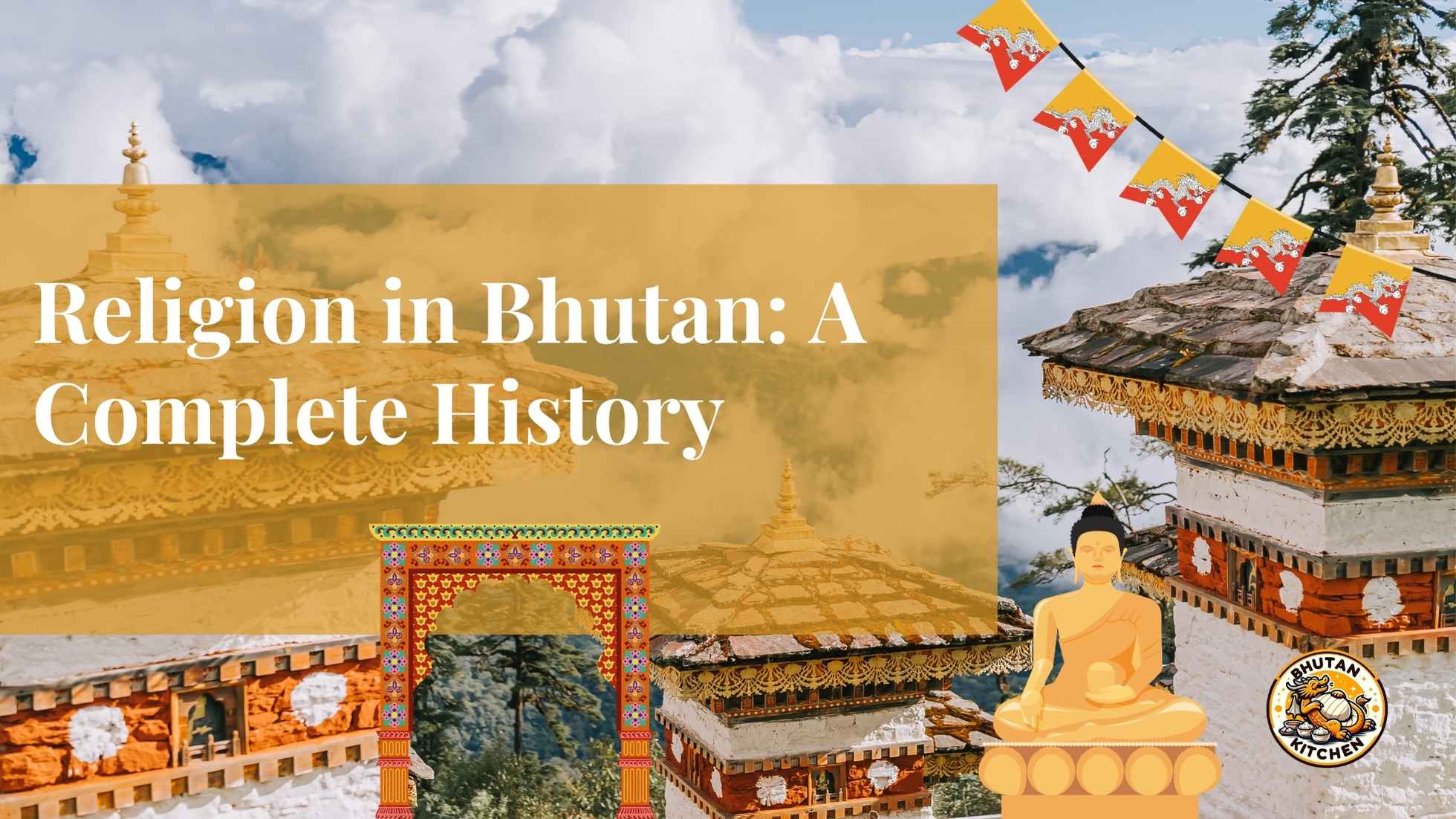
Religion in Bhutan is not confined to monasteries or scripture. It appears in the prayer flags stretched across mountain passes, the butter lamps glowing on household altars, the masked dances performed in dzong courtyards, and the small offerings placed beside a meal.
It also appears in the kitchen.
Bhutan’s chillies, cheese, butter, red rice, dried meat, fermented vegetables, dumplings, festival drinks, and vegetarian dishes developed within a society shaped by Himalayan geography and more than a thousand years of religious change. Indigenous beliefs, Vajrayana Buddhism, Hindu traditions, monastic institutions, local agriculture, and seasonal necessity all contributed to the country’s food culture.
Today, approximately 75 percent of Bhutan’s population identifies as Buddhist, according to Pew Research Center’s 2025 global religious estimates. Hinduism is the country’s second-largest religion and is particularly important in southern Bhutan.
Yet percentages alone cannot explain religion in Bhutan. Belief is layered. A Buddhist household may honor local deities, consult an astrologer, make offerings to territorial spirits, attend a monastery festival, and observe customs that long predate the formal arrival of Buddhism.
To understand Bhutanese cuisine, it helps to understand this layered spiritual history first.
What Is the Main Religion in Bhutan?
The main religion in Bhutan is Vajrayana Buddhism, particularly the Drukpa Kagyu and Nyingma traditions.
Bhutan is often described as a Buddhist state, but its constitutional wording is more precise. Article 3 of the 2008 Constitution states that Buddhism is the country’s “spiritual heritage.” It also declares the Druk Gyalpo, or King of Bhutan, the protector of all religions and requires religious institutions to remain separate from politics.
This distinction matters. Buddhism plays a central role in Bhutanese identity, public ceremony, art, architecture, education, and ethics, but the Constitution also protects freedom of thought, conscience, and religion.
Religion in Bhutan at a Glance
| Religious tradition | Approximate presence | Where it is most visible |
|---|---|---|
| Vajrayana Buddhism | About 75% | Monasteries, dzongs, household altars, tshechus, prayer flags, chortens |
| Hinduism | About 22% | Southern Bhutan, temples, family ceremonies, festivals and vegetarian traditions |
| Christianity and other faiths | Small minorities | Primarily private, household and urban religious communities |
| Indigenous and local practices | Difficult to measure separately | Spirit rituals, agricultural ceremonies, healing traditions and household offerings |
The categories overlap. Indigenous practices are rarely separated cleanly from Buddhism in everyday life, which makes exact measurement difficult. And here is the snapshot of religion in Bhutan over time and what we are covering next..
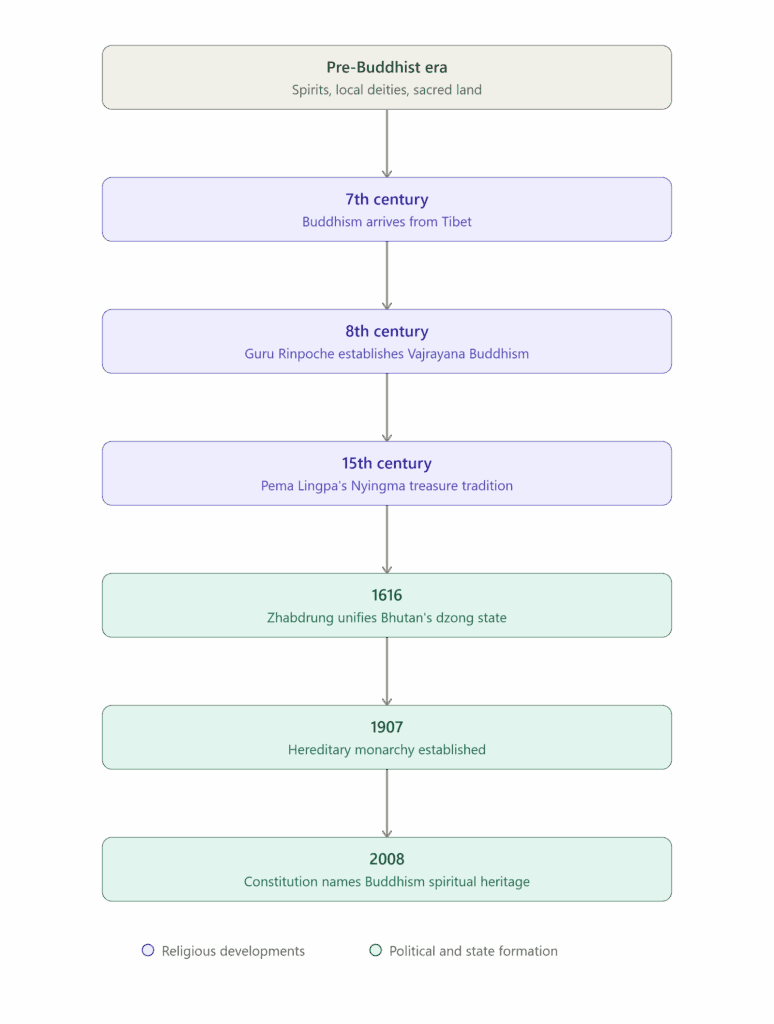
Before Buddhism: Indigenous Beliefs and the Bön Question
Before Buddhism spread through the eastern Himalayas, communities in the region lived within a sacred landscape.
Mountains, forests, lakes, cliffs, rivers, caves, trees, and cultivated fields could be associated with spiritual beings. Illness, storms, crop failure, infertility, household conflict, and unexpected misfortune might be interpreted as signs of imbalance between people and the unseen world.
Ritual specialists performed ceremonies intended to restore harmony. Offerings could include grain, butter, incense, water, beer, dough figures, flowers, or symbolic objects.
These early practices are often grouped under the label Bön. However, the term should be used carefully.
Bön can refer to the organized Tibetan religious tradition that later developed its own monasteries, scriptures, philosophy, and clergy. It can also be used more loosely for older Himalayan beliefs involving animism, shamanism, ancestral powers, and local deities. These are related categories, but they are not necessarily identical.
For Bhutan, it is more accurate to speak of a broad pre-Buddhist and indigenous religious foundation rather than imagining one uniform national religion called Bön.
The Sacred Landscape
Several ideas from this older religious world remain important:
- Natural places can possess spiritual power.
- Local deities may protect a village, valley, household, or lineage.
- Human activity can disturb unseen beings.
- Agricultural success depends on both physical labor and spiritual balance.
- Food and drink can function as offerings, not merely nourishment.
These beliefs help explain why food remains part of household rituals in Bhutan. Rice, butter, water, incense, fruit, alcohol, and prepared dishes may be presented symbolically to deities, teachers, ancestors, or protective forces.
The practice is not simply superstition added to Buddhism. It reflects a much older Himalayan understanding that eating connects human life with land, animals, weather, community, and the sacred.
The Arrival of Buddhism in Bhutan
Buddhist influence reached the region over several centuries through Tibet, the Indian subcontinent, and neighboring Himalayan territories.
Traditional Bhutanese histories connect some of the country’s oldest temples with the Tibetan king Songtsen Gampo, who ruled during the seventh century. Kyichu Lhakhang in Paro and Jambay Lhakhang in Bumthang are traditionally included among a network of temples built to subdue a giant demoness believed to obstruct the spread of Buddhism.
The historic details of these foundation stories are difficult to verify fully. Their cultural importance, however, is undeniable. They locate Bhutan within the sacred geography of Tibetan Buddhism and present the landscape itself as something transformed through religious practice.
Guru Rinpoche and the Establishment of Vajrayana Buddhism
The figure most closely associated with Buddhism’s establishment in Bhutan is Padmasambhava, better known as Guru Rinpoche, or “Precious Master.”
Guru Rinpoche was an eighth-century tantric teacher credited with helping establish Buddhism in Tibet. Bhutanese tradition holds that he visited several parts of present-day Bhutan, subdued hostile spiritual forces, taught Vajrayana practices, and concealed spiritual treasures for later discovery.
His influence is especially strong in Bumthang, where stories connect him with Kurjey Lhakhang, and in Paro, where he is associated with Taktsang Monastery.
Tiger’s Nest and the Flying Tigress
Paro Taktsang, commonly known as Tiger’s Nest, is Bhutan’s most famous monastery.
According to sacred tradition, Guru Rinpoche flew to the site on the back of a tigress, often identified as a transformed manifestation of his disciple Yeshe Tsogyal. He meditated in a cave and subdued obstructing forces.
The monastery complex visible today was constructed centuries later, but the site’s sacred identity comes from its association with Guru Rinpoche.
The story illustrates an important feature of Vajrayana Buddhism in Bhutan: older deities and spirits were not always rejected. They were often interpreted as forces that could be transformed, bound by oath, and made into protectors of Buddhist teaching.
This process allowed Buddhism to take root without erasing the spiritual character of the land.
What Makes Vajrayana Buddhism Different?
Vajrayana Buddhism is sometimes called the Diamond Vehicle or Thunderbolt Vehicle. It belongs to the wider Mahayana Buddhist tradition but places particular emphasis on tantric methods transmitted through qualified teachers.
Common Vajrayana practices include:
- Mantra recitation
- Meditation and visualization
- Ritual offerings
- Mandalas
- Sacred dance
- Initiations and empowerments
- Devotion to teachers and lineage
- Practices involving peaceful and wrathful deities
- The ritual transformation of ordinary experience
In Bhutan, Vajrayana Buddhism is not only a philosophy. It is a lived visual and ceremonial system.
It shapes the design of monasteries, the subjects painted on walls, the masks used in sacred dances, the orientation of buildings, the dates chosen for important events, and the prayers recited before journeys, construction projects, harvests, marriages, and meals.
The Nyingma and Drukpa Kagyu Traditions
Two Vajrayana traditions have been particularly influential in Bhutan: Nyingma and Drukpa Kagyu.
Nyingma
Nyingma means “the ancient school.” It traces its origins to the earliest period of Buddhism’s transmission to Tibet and gives Guru Rinpoche a central role.
Nyingma traditions became deeply established in central and eastern Bhutan. Treasure revealers, known as tertöns, played an important role by discovering teachings believed to have been concealed by Guru Rinpoche and his disciples for future generations.
One of Bhutan’s most famous religious figures, Pema Lingpa, was a fifteenth-century treasure revealer from Bumthang. His teachings, sacred dances, temples, artistic traditions, and descendants remain important to Bhutanese culture.
Drukpa Kagyu
The Drukpa Kagyu tradition developed from the Kagyu school of Tibetan Buddhism.
The word Druk means thunder dragon. It became associated with the lineage of Tsangpa Gyare and later with Bhutan itself, which is known in Dzongkha as Druk Yul, the Land of the Thunder Dragon.
Drukpa Kagyu institutions became especially powerful in western Bhutan. During the seventeenth century, Zhabdrung Ngawang Namgyal used the lineage as the spiritual and political foundation of a unified Bhutanese state.
Comparing Bhutan’s Major Buddhist Traditions
| Tradition | Meaning | Historical importance in Bhutan | Continuing influence |
|---|---|---|---|
| Nyingma | “Ancient school” | Closely associated with Guru Rinpoche and treasure traditions | Strong in eastern and central Bhutan, sacred dances, pilgrimage sites and local lineages |
| Drukpa Kagyu | Kagyu lineage of the Thunder Dragon | Became the institutional foundation of the unified Bhutanese state | Central Monastic Body, state ceremonies, major monasteries and national identity |
These traditions are distinct, but they coexist within Bhutan’s wider Vajrayana culture.
Zhabdrung Ngawang Namgyal and the Unification of Bhutan
The most important political and religious figure in the formation of Bhutan was Zhabdrung Ngawang Namgyal.
He arrived in Bhutan from Tibet in 1616 after a dispute involving authority over the Drukpa Kagyu lineage. Over the following decades, he united previously competing valleys, defeated military invasions, established administrative institutions, and built a network of fortress-monasteries.
His achievement was not simply territorial. He created a shared political identity grounded in the Drukpa religious tradition.
The Dzong as Fortress, Monastery and Government
The Zhabdrung built or expanded dzongs across Bhutan.
A dzong could serve several functions at once:
- Religious center
- Monastic residence
- Administrative headquarters
- Military fortress
- Storehouse
- Symbol of national authority
Punakha Dzong became one of the most important centers of the new state. Located at the meeting of the Pho Chhu and Mo Chhu rivers, it remains the winter residence of Bhutan’s Central Monastic Body.
Other dzongs linked governance to monastic life throughout the country. Their architecture physically expressed the idea that spiritual and temporal authority were connected.
The Dual System of Governance
Zhabdrung Ngawang Namgyal established a system known as the chösi, often translated as the Dual System of religious and secular governance.
Under this arrangement:
- The Je Khenpo served as the chief religious authority.
- The Druk Desi managed secular administration.
- The Zhabdrung stood above both as the unifying source of authority.
The system continued after the Zhabdrung’s death, although political fragmentation and rivalry gradually weakened central rule.
The Dual System left a lasting mark. Bhutan’s modern government is secular and democratic, but the Je Khenpo and the Central Monastic Body continue to hold major ceremonial and cultural importance.
Religion and the Rise of the Bhutanese Monarchy
By the nineteenth century, conflicts among regional governors had weakened the old political system.
Ugyen Wangchuck, the powerful governor of Trongsa, eventually emerged as the country’s leading political figure. In 1907, representatives of the monastic community, government officials, and regional leaders selected him as Bhutan’s first hereditary king.
The monarchy did not abolish Bhutan’s Buddhist institutions. Instead, it became a new source of unity while continuing to support the country’s spiritual heritage.
In 2008, Bhutan formally became a democratic constitutional monarchy. The Constitution recognizes Buddhism’s special historical role while requiring religion and politics to remain separate. (Constitute Project)
The Central Monastic Body and the Je Khenpo
Bhutan’s Central Monastic Body, or Zhung Dratshang, is led by the Je Khenpo.
It plays a major role in:
- Monastic education
- Religious ceremonies
- National prayers
- Preservation of rituals
- Sacred dance
- Astrology
- Temple administration
- Public blessings
- Funeral rites
- Important state occasions
The monastic community traditionally moves seasonally between Thimphu and Punakha. Punakha’s warmer winter climate made it a suitable seasonal religious capital.
Monks remain highly visible throughout Bhutan, but they are not the only religious specialists. Village priests, lay tantric practitioners, nuns, astrologers, ritual experts, and household elders also sustain religious practice.
Hinduism and Religious Diversity in Bhutan
A complete account of religion in Bhutan must include Hinduism.
Many southern Bhutanese, particularly members of Lhotshampa communities, follow Hindu traditions. Hindu life in Bhutan includes temple worship, household rituals, festivals, vegetarian observances, devotional practices, and ceremonies connected with birth, marriage, and death.
Hinduism represents roughly one-fifth to one-quarter of the population, although estimates vary.
Dashain, Diwali, and other Hindu festivals are celebrated in southern communities. These traditions contribute to Bhutan’s food culture through sweets, rice dishes, lentils, vegetable preparations, ritual fasting, and festival meals.
Bhutan is also home to smaller Christian and other religious communities. The Constitution protects freedom of religion, although international reports continue to document challenges related to registration, conversion, and public religious activity.
Religion in Everyday Bhutanese Life
The most visible religious monuments in Bhutan are spectacular, but ordinary religious practice is often quiet.
A family may begin the day by lighting a butter lamp. A driver may place an image of Guru Rinpoche on the dashboard. A shopkeeper may burn incense before opening. A farmer may consult an astrologer before beginning construction. A traveler may add a stone to a sacred cairn while crossing a mountain pass.
Common Religious Features in the Landscape
| Feature | Meaning or function |
|---|---|
| Prayer flags | Carry printed prayers and blessings through wind |
| Chortens | Sacred monuments associated with the Buddha’s mind and teachings |
| Mani walls | Stones inscribed with mantras, often passed on the left in respectful circumambulation |
| Prayer wheels | Cylinders containing prayers that are rotated as a devotional act |
| Butter lamps | Offerings associated with light, wisdom and the removal of ignorance |
| Household altars | Places for prayer, offerings and images of teachers or deities |
| Sacred trees and springs | Sites associated with local spirits, blessings or healing |
These practices turn the landscape into a religious environment. A road is also a pilgrimage route. A mountain is also the home of a deity. A meal is also an opportunity to make merit.
Tshechus: Bhutan’s Sacred Festival Tradition
A tshechu is a religious festival commonly held on or around the tenth day of a lunar month associated with Guru Rinpoche.
Almost every district has its own tshechu. Some last several days and take place in the courtyard of a dzong or monastery.
The central performances are often cham dances, ritual masked dances performed by monks or trained lay practitioners.
Cham is not simply entertainment. The dances can:
- Represent episodes from Buddhist history
- Invoke protective deities
- Teach moral lessons
- Purify negative influences
- Prepare viewers to recognize sacred forms
- Generate religious merit
Families attend wearing formal national dress, meet relatives, socialize, pray, picnic, and receive blessings. Read more about these Bhutanese festivals here.
The Thongdrel
At major tshechus, a giant embroidered or appliquéd religious image called a thongdrel may be unfurled before sunrise.
Its name is commonly explained as “liberation through seeing.” Viewing the sacred image is believed to purify obstacles and create merit.
The thongdrel is displayed briefly to protect it from sunlight and weather, making the moment both rare and powerful.
The Buddhist Calendar and Food
Religion influences food in Bhutan partly through the lunar calendar.
Sacred days may encourage people to:
- Avoid meat
- Refrain from alcohol
- Visit temples
- light butter lamps
- Make donations
- Feed monks
- Release animals
- Eat simpler meals
- Prepare food for communal gatherings
The exact dates and level of observance vary by family, region, institution, and year.
Bhutan has also regulated the sale and slaughter of animals during selected auspicious periods. The Livestock Act of 2001 restricted slaughter and meat sales during specified sacred dates and months. In late 2025, Bhutan’s National Assembly debated updated livestock legislation that would expand some of these restrictions.
This is more accurate than saying Bhutanese people never eat meat or that all slaughter has been permanently prohibited. Meat remains part of Bhutanese cuisine, but its production and consumption exist within a strong ethical and religious tension.
How Religion Shaped Bhutanese Cuisine
Religion did not single-handedly create Bhutanese cuisine.
Geography, altitude, climate, trade, migration, farming, food preservation, and contact with Tibet, India, Nepal, and China were equally important. Bhutanese cuisine developed from what people could grow, herd, store, ferment, dry, transport, and cook in a mountainous environment.
Religion shaped how these foods were valued, offered, restricted, shared, and scheduled.
The relationship can be understood through six major influences.
1. Compassion and the Moral Complexity of Eating Meat
Buddhist ethics place great importance on compassion and avoiding the taking of life.
Bhutanese people have nevertheless eaten pork, beef, chicken, yak, dried meat, and other animal foods for generations. This may appear contradictory, but it reflects a distinction often found in Himalayan Buddhist societies between killing an animal and eating meat obtained through trade or slaughter performed by someone else.
The distinction does not remove the ethical problem. It manages it.
For many Bhutanese families, meat may be avoided on sacred days, during religious retreats, after the death of a relative, or when performing practices intended to accumulate merit.
At other times, meat appears in everyday and celebratory dishes.
Meat and Vegetarian Food in Bhutan
| Context | Common tendency |
|---|---|
| Auspicious Buddhist days | Greater likelihood of vegetarian meals |
| Monastic ceremonies | Vegetarian dishes are often preferred, depending on the institution |
| Weddings and celebrations | Meat dishes may be served generously |
| Funerary or merit-making periods | Families may avoid meat for a set time |
| Daily household meals | Practices differ according to family, region, income and belief |
| Government-restricted dates | Slaughter or meat sales may be limited |
This tension helped create a cuisine where vegetarian and meat dishes coexist naturally.
Ema datshi, kewa datshi, shamu datshi, vegetable momos, lentils, buckwheat dishes, greens, radish, cheese, and rice are not modern substitutes for meat. They belong to the center of the cuisine.
2. Dairy Became a Foundation of Flavor
Cheese and butter are among the defining ingredients of Bhutanese food.
The word datshi means cheese. It appears in several of the country’s best-known dishes:
- Ema datshi: chillies and cheese
- Kewa datshi: potatoes and cheese
- Shamu datshi: mushrooms and cheese
- Saag datshi: leafy greens and cheese
Dairy’s importance reflects pastoral life, climate, high-altitude agriculture, and access to cattle and yak products.
Religion also contributed indirectly. In a culture where killing animals could carry moral consequences, livestock could remain valuable as sources of milk, butter, cheese, manure, labor, and household wealth.
Cheese gave vegetarian meals richness and energy. Butter supported ritual life as well as cooking.
3. Butter Is Both Food and Offering
Butter has a special place in Himalayan Buddhist cultures.
It is used in:
- Butter tea
- Religious lamps
- Ceremonial sculptures
- Temple offerings
- Festival foods
- Household cooking
- Hospitality
A butter lamp transforms an everyday agricultural product into a symbol of wisdom and illumination.
The same ingredient can therefore move between altar and kitchen. It can light a shrine, enrich a cup of tea, or flavor a ceremonial dish.
Suja: Bhutanese Butter Tea
Suja is Bhutanese butter tea, usually made with tea, butter, salt, and water.
It is especially welcome in cold weather and at high altitude. Suja may be served to guests, offered during ceremonies, or consumed with snacks such as roasted rice.
Its significance is practical and social. The drink provides warmth and energy, but it also communicates welcome.
Serving tea is one of the simplest ways a Bhutanese household turns food into hospitality.
4. Food Offerings Connect the Kitchen to the Sacred
In many Bhutanese homes, the first portion of food or drink may be offered before the family eats.
Offerings vary, but can include:
- Rice
- Tea
- Water
- Butter
- Fruit
- Biscuits
- Alcohol
- Cooked food
- Incense
Some offerings are made at a household altar. Others may be directed toward local deities, protective spirits, teachers, ancestors, or unseen beings.
The practice encourages gratitude and restraint. Food is acknowledged as something received through many causes: soil, rain, animals, farmers, cooks, traders, family, and fortune.
At Bhutan Kitchen in Bangkok, we continue this connection in a simple way by offering a small portion of rice at the kitchen altar before service. Guests may not see the ritual, but it expresses the same principle found in Bhutanese homes: a meal begins with gratitude.
5. Festivals Created a Calendar of Special Foods
Religious festivals do not always have one standardized national menu. Food varies by valley, family, season, and available ingredients.
Still, several broad patterns appear.
Tshechu Food
Families attending a tshechu may bring a picnic or share prepared food in and around the festival grounds.
Meals may include:
- Red rice
- Ema datshi
- Pork or beef dishes
- Momos
- Dried meat
- Cheese
- Ezay
- Tea
- Ara or bangchang
The food supports a full day of prayer, dancing, socializing, and waiting for blessings.
Losar Food
Losar, the New Year celebration, is associated with abundant meals, hospitality, visiting, and drinking.
Depending on the region, families may prepare:
- Dumplings
- Fried snacks
- Rice
- Meat dishes
- Cheese dishes
- Noodles
- Ara
- Special breads or biscuits
The meal marks renewal and expresses the hope that the coming year will be prosperous.
Lomba and Hoentay
In Haa and Paro, the regional New Year celebration known as Lomba is associated with hoentay, buckwheat dumplings traditionally filled with ingredients such as turnip greens, cheese, butter, and spices.
Hoentay shows how religion, agriculture, and regional identity meet in one dish. The celebration provides the occasion, while buckwheat and preserved ingredients reflect the highland environment.
Hindu Festival Foods
In southern Bhutan, Hindu festivals add another layer to the country’s culinary calendar.
Vegetarian meals, lentils, rice, sweets, dairy, fruit, and ritual foods may be prepared for religious occasions. The exact dishes depend on family tradition and regional influence.
6. Monasteries Encouraged Giving, Simplicity and Communal Eating
Food offered to monks is a traditional form of generosity.
Families may sponsor meals during ceremonies, retreats, funerals, anniversaries, or merit-making events. Donations can include rice, vegetables, butter, cheese, tea, flour, oil, money, and prepared dishes.
The act matters as much as the menu. Feeding the monastic community allows laypeople to support religious practice and accumulate merit.
Monastery food should not be reduced to one universal meal plan. Diets differ across institutions, regions, seasons, and levels of funding.
However, rice, vegetables, chillies, cheese, tea, soups, lentils, and simple curries commonly fit the practical demands of feeding groups.
Communal religious meals also reinforced several habits found throughout Bhutanese society:
- Cooking in large pots
- Sharing several dishes
- Serving guests repeatedly
- Valuing filling, warming foods
- Avoiding waste
- Treating feeding others as a virtue
Bhutanese Dishes and Their Religious Connections
No Bhutanese dish has only one origin. Each reflects agriculture, trade, environment, household taste, and historical change.
Still, many dishes illustrate the relationship between spiritual life and food.
| Dish | Main ingredients | Religious or cultural connection |
|---|---|---|
| Ema datshi | Chillies and cheese | A satisfying meat-free staple suited to fasting or restraint days |
| Kewa datshi | Potatoes, cheese and chillies | Common vegetarian household comfort food |
| Shamu datshi | Mushrooms, cheese and chillies | Connects forest ingredients with the datshi tradition |
| Red rice | Bhutanese red rice | Everyday staple used in household, festival and ceremonial meals |
| Suja | Tea, butter and salt | Hospitality drink with connections to monastic and Himalayan life |
| Momos | Filled dumplings | Shared at gatherings, festivals and family occasions |
| Hoentay | Buckwheat dumplings | Closely associated with the Lomba celebration in western Bhutan |
| Phaksha paa | Pork, chillies and vegetables | Illustrates the continuing place of meat in Bhutanese food |
| Shakam paa | Dried beef, chillies and vegetables | Reflects mountain preservation techniques and winter preparation |
| Ezay | Chilli condiment | Everyday accompaniment that intensifies both vegetarian and meat meals |
| Ara | Distilled grain alcohol | Used socially and sometimes ceremonially, with customs varying by community |
| Bangchang | Fermented grain drink | Associated with hospitality, rural life and certain offerings |
Is Bhutanese Food Vegetarian?
Bhutanese food is not exclusively vegetarian.
Buddhist ethics have made vegetarianism and meat abstention culturally important, but many Bhutanese people eat meat. Pork, beef, chicken, yak, and dried meat appear in traditional cuisine.
A better description is that Bhutanese cuisine has a strong independent vegetarian tradition alongside its meat dishes.
Vegetarian Bhutanese food does not depend on imitation products. It is built around potatoes, mushrooms, buckwheat, rice, turnips, radish, leafy greens, beans, cheese, butter, chillies, and fermented vegetables.
This is one reason the cuisine adapts well to vegetarian diners.
Did Buddhism Make Bhutanese Food Spicy?
Buddhism did not directly cause Bhutanese people to eat chillies.
Chillies originated in the Americas and reached Asia through global trade after the Columbian Exchange. Their adoption in Bhutan occurred long after Buddhism arrived.
The popularity of chillies is better explained by taste, climate, agriculture, preservation, trade, and the way chilli works with dairy and staple grains.
Religion influenced the occasions on which particular dishes were eaten, but it did not introduce the chilli itself.
This distinction is important. Culture develops through several forces at once.
Ema datshi may suit a Buddhist meatless day, but the dish also depends on historical crop exchange, local cheese production, and Bhutan’s preference for intense warming flavors.
Religion, Hospitality and the Ethics of Sharing Food
One of religion’s deepest influences on Bhutanese cuisine is not a specific ingredient. It is the belief that feeding people has moral value.
A guest is rarely offered nothing.
Tea, rice, snacks, fruit, alcohol, or a full meal may be served depending on the household and occasion. Refusing too quickly can prompt another offer because generosity is part of good social conduct.
This culture of hospitality reflects several overlapping values:
- Buddhist generosity
- Respect for guests
- Community interdependence
- Rural food-sharing traditions
- The accumulation of merit
- The belief that abundance should circulate
Food is therefore more than private consumption. It builds relationships.
Religion and Food Waste
Buddhist teachings on interdependence and gratitude encourage respect for food, although modern waste remains a challenge everywhere.
In a traditional household, ingredients required labor to grow, herd, collect, ferment, dry, grind, or transport. Wasting food meant wasting the work of people, animals, land, and weather.
Religious offerings reinforce this awareness by asking diners to pause before eating.
The point is not that every Bhutanese household follows the same rule. It is that the culture contains a strong moral language for seeing food as precious.
How Bhutanese Religion Continues to Change
Bhutan is modernizing rapidly.
Urbanization, tourism, migration, education, smartphones, imported food, supermarkets, restaurant culture, and international media are changing how people worship and eat.
Young Bhutanese may consume more packaged food, dine outside the home, follow global diets, or observe religious restrictions differently from their grandparents.
At the same time, monasteries remain active, tshechus attract large crowds, pilgrimage continues, and household rituals survive.
Religion in Bhutan is not frozen in the past. It adapts.
The same is true of the cuisine.
A restaurant may serve traditional ema datshi with a different cheese. A family may prepare a vegetarian version of a meat dish. A Bhutanese cook abroad may substitute local vegetables while preserving the dish’s flavor and social meaning.
Tradition survives not by remaining untouched, but by retaining a recognizable structure through change.
Experiencing Bhutanese Culture Through Food in Bangkok
Bhutan Kitchen is not a monastery or religious institution. It is a Bhutanese restaurant in Bangkok serving the flavors of the Himalayas.
Still, each dish carries part of Bhutan’s cultural history.
The cheese in ema datshi reflects the importance of dairy in mountain life. The meat-free datshi dishes belong to a cuisine shaped by recurring acts of restraint. Suja connects hospitality with the cold landscapes of the Himalayas. Momos evoke family gatherings, journeys, and festivals. Red rice brings the Bhutanese field to the table.
Eating Bhutanese food does not provide a complete understanding of Vajrayana Buddhism. It does, however, offer a sensory introduction to the society in which that tradition developed.
You taste the practical results of altitude, agriculture, ethics, ritual, preservation, hospitality, and memory.
Explore our guide to Bhutanese cuisine, dishes, ingredients and dining customs for a deeper look at the country’s food traditions.
You can also discover why ema datshi is known as Bhutan’s national dish.
Frequently Asked Questions
What is the official religion of Bhutan?
Bhutan’s Constitution does not use the phrase “official state religion.” It recognizes Buddhism as the country’s spiritual heritage and identifies the King as protector of all religions. Vajrayana Buddhism, especially the Drukpa Kagyu and Nyingma traditions, is practiced by most Bhutanese people.
What percentage of Bhutan is Buddhist?
Recent international estimates place Bhutan’s Buddhist population at approximately 75 percent. Hinduism is the second-largest religion, practiced mainly in southern communities.
What is the difference between Drukpa Kagyu and Nyingma Buddhism?
Nyingma is the oldest major school of Tibetan Buddhism and is closely associated with Guru Rinpoche and the treasure tradition. Drukpa Kagyu is a branch of the Kagyu school that became central to Bhutan’s political unification and national identity.
Is Bön still practiced in Bhutan?
Practices associated with indigenous spirits, local deities, sacred landscapes, divination, and household rituals remain present. However, they are often integrated with Buddhism rather than identified as a separate religion.
Do Bhutanese Buddhists eat meat?
Many do. Buddhist ethics discourage killing, and some people avoid meat on sacred days or during religious observances. However, pork, beef, chicken, yak, and dried meat remain part of Bhutanese cuisine.
Is animal slaughter illegal in Bhutan?
Bhutan has historically restricted slaughter and meat sales on selected auspicious dates and during sacred periods. The exact law and enforcement have changed over time, so the claim that all animal slaughter is permanently illegal is too broad.
Why is cheese so important in Bhutanese cuisine?
Cheese provides fat, protein, richness, and warmth in a mountainous agricultural society. It also makes vegetarian dishes substantial, which is useful in a culture where many people periodically abstain from meat.
What food is eaten during Bhutanese religious festivals?
Festival foods vary by region and family. Common choices include red rice, ema datshi, momos, meat dishes, cheese, ezay, butter tea, ara, and fermented grain drinks. Hoentay is particularly associated with Lomba in western Bhutan.
What is the religious meaning of butter tea?
Butter tea is primarily a practical and hospitable drink rather than a sacrament. However, butter also has ritual importance because it is used in lamps, offerings, and ceremonial art.
How does religion influence Bhutanese restaurants?
Restaurants may offer strong vegetarian selections, adapt menus during religious periods, and serve dishes associated with festivals and hospitality. The influence is cultural rather than governed by one universal set of restaurant rules.
Conclusion
The history of religion in Bhutan is a story of layers.
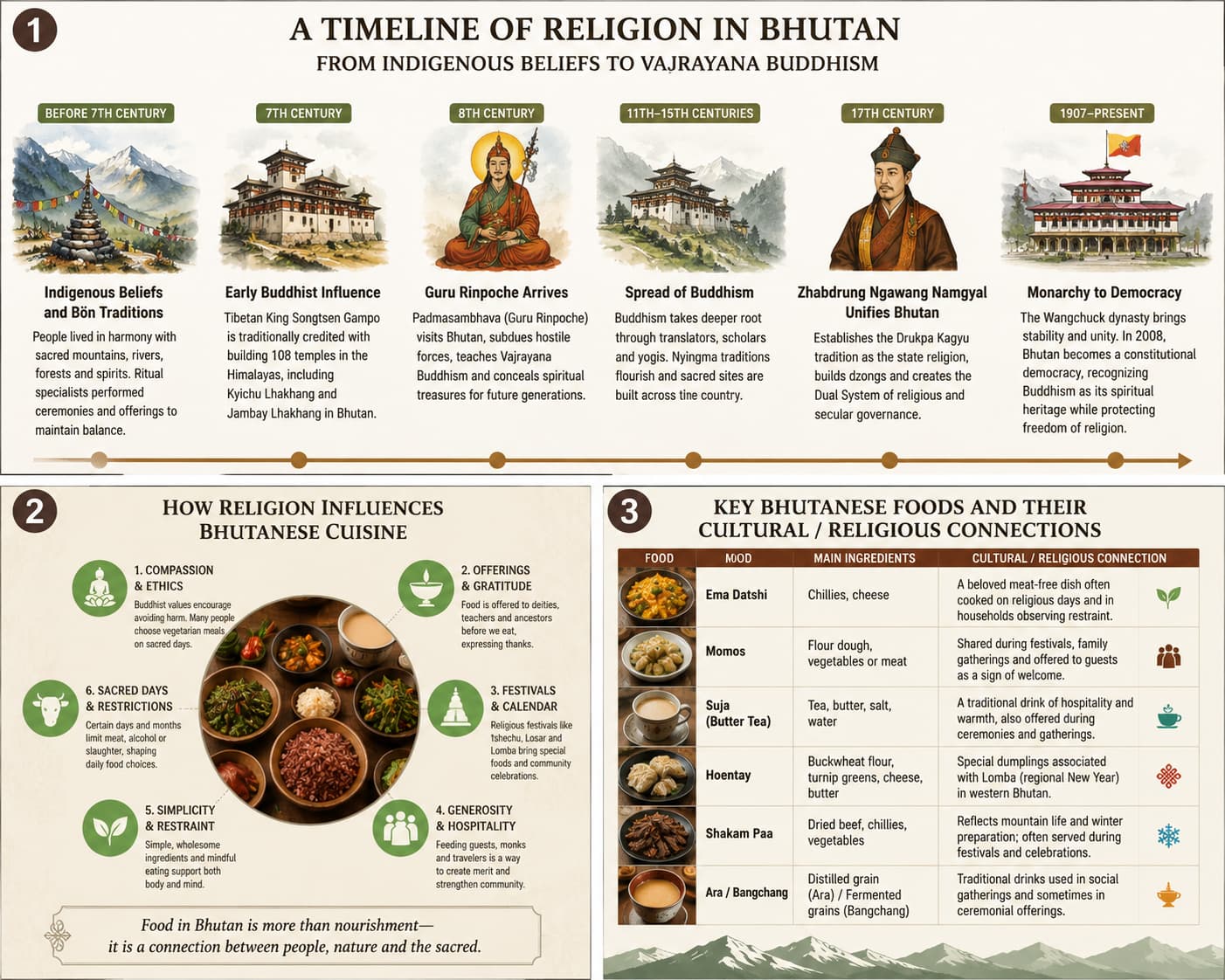
Indigenous Himalayan beliefs created a sacred landscape filled with mountains, rivers, spirits, ancestors, and protective forces. Guru Rinpoche and later Buddhist teachers brought Vajrayana traditions that transformed many of those forces into guardians of the Dharma. Nyingma masters, treasure revealers, Drukpa Kagyu hierarchs, village priests, monastic communities, Hindu families, and household practitioners all aded to the country’s spiritual life.
During the seventeenth century, Zhabdrung Ngawang Namgyal turned religious identity into the foundation of a unified state. Dzongs joined monastery, government, fortress, and storehouse within a single structure. The monarchy later preserved this spiritual heritage while Bhutan developed into a modern constitutional democracy.
Bhutanese cuisine grew inside this world.
Religion did not invent red rice, cheese, chillies, buckwheat, dried meat, or fermentation. Geography and agriculture supplied the ingredients. Religious values gave them rhythm and meaning.
They influenced when meat was avoided, how food was offered, why monks were fed, how festivals were celebrated, and why hospitality became a moral act.
That is the deepest connection between religion and Bhutanese food.
It is not that every dish has a sacred origin. It is that the entire cuisine developed in a culture where eating has never been only about hunger.
It is also about gratitude, restraint, generosity, memory, community, and the relationship between human beings and the living landscape around them.