
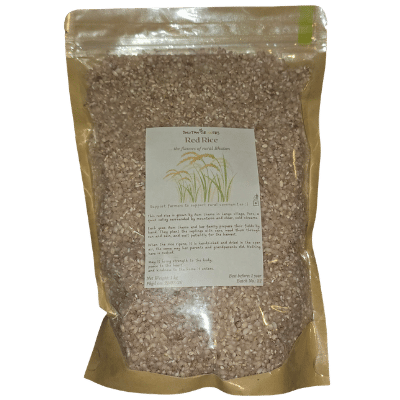
Organic Red Rice from Paro Valley
For over a thousand years, fed by the mineral-rich meltwaters of a 1,000‑year‑old glacier, Bhutanese farmers have quietly cultivated one of the world’s most precious heirloom grains. Grown at nearly 9,000 ft above sea level in the fertile valleys of Paro, Punakha and Wangdue Phodrang, our organic red rice is more than a staple, it’s a Bhutanese delicacy.
This medium‑grain rice is semi‑milled, meaning it keeps its beautiful russet bran layer intact while still cooking in just 20 minutes, much faster than ordinary brown rice. Its flavour is deeply earthy and nutty, with a delightfully soft, slightly sticky texture. When cooked, the grains turn a delicate pink, making every dish a feast for the eyes as well as the palate.
How to enjoy this ancient grain in Bangkok:
Grown manually without synthetic pesticides or chemical fertilisers, this grain is a Slow Food Ark of Taste heritage product—recognised worldwide as a food worth preserving. Every purchase directly supports smallholder farmers like Aum Lhamo in Lango village, Paro, who continue to tend their ancestral fields by hand. May it bring strength to the body, peace to the heart, and kindness to the home it enters.
Net Weight: 1kg

Bhutanese red rice (known locally as Chhumm Marp or Yee Chhumm) is a medium‑grain japonica rice that has been cultivated in the Kingdom of Bhutan for over a thousand years. It is traditionally grown in the western‑central valleys of Paro, Punakha and Wangdue Phodrang at altitudes approaching 9,000 ft (2,700 m) above sea level, where it is irrigated by mineral‑rich glacial meltwaters.
For centuries, red rice was the everyday staple of Bhutanese people, and it remains deeply interwoven with the country’s cultural and spiritual life. Historically, it symbolised abundance during festivals and religious ceremonies. Because it is more expensive to produce than white rice (the yield is low, as it is grown without chemical fertilisers), red rice is now often reserved for special occasions such as weddings, national holidays and religious feasts.
Today, approximately 200 small‑scale producers of mostly family farms, keep this ancient grain alive. The rice is grown manually, without synthetic pesticides or chemical fertilisers, using methods passed down through generations. After harvest, the paddy is sun‑dried, then semi‑milled so that some of the reddish bran remains, giving the rice its characteristic colour, nutty flavour and higher nutritional value.
In 2015, Bhutanese red rice was officially added to the Slow Food Foundation’s Ark of Taste which is an international catalogue of endangered heritage foods that are sustainably produced, unique in taste and part of a distinct ecoregion. It remains the only agricultural product imported from Bhutan into the United States and has been featured on tasting menus of award‑winning restaurants such as Bom, which uses it to reference Himalayan terroir.
Aum Lhamo of Lango village, Paro is one of the dedicated farmers continuing this legacy. Each year, she and her family prepare their fields by hand, plant the saplings with care, weed them through sun and rain, and wait patiently for the harvest. When the rice ripens, it is handpicked and dried in the open air, exactly as her parents and grandparents did. Nothing here is rushed.
Dietary Pros:
Nutritional Excellence:
Bhutanese red rice is a nutritional powerhouse. As a whole grain, it is a great source of protein, potassium, manganese, selenium, calcium, magnesium, iron, zinc and B vitamins. It is known to have higher levels of iron and zinc than white, black or brown rice. Its beautiful colour comes from anthocyanins, the same antioxidant pigments found in berries and red grapes, which help combat oxidative stress.
Health & Lifestyle Benefits:
Here are three authentic ways to bring this ancient grain into your kitchen:
Cooking Tip: Before cooking, rinse the rice in cold water and soak for 15 minutes. Use a ratio of 1 cup of rice to 1.5 cups of water (or 350ml of water for 1 cup of rice). Cook on the stovetop or in a rice cooker for 20 minutes, then let it stand covered for 4‑5 minutes before fluffing.