Thailand and Bhutan are spiritual neighbours, fellow Buddhist-majority countries, and both know their way around chili. But the kitchens barely talk to each other. This guide does just that: it puts similar dishes from each cuisine side by side, dish for dish, so the next time you eat one you can taste the other in your head.
We work with Bhutanese food every day at Bhutan Kitchen, so this one is a little personal – we love both cuisines. The aim here is to be useful, not tribal.
By the numbers: chili first
We have to start with chili, because that’s where the gap opens up.
- Bhutan is the world’s #1 consumer of chilies per capita. The average Bhutanese eats roughly 41 grams of chili a day – that’s about 287 grams per week with the top end estimated closer to 1kg a week, so on average roughly 16-17 kilograms per year.
- Thailand is also a heavy chili user by global standards – about 5 grams per day, per person, or ~1.8 kg per year – putting Thais in the top 5 chili-eating populations on earth.
- The ratio: a Bhutanese eater consumes roughly 8 times more chili by weight than a Thai eater as they use chili as a primary ingredient.
So if the saying is “Thai food is hot,” Bhutanese food isn’t just hotter. It’s a different relationship with chili entirely and closer to the way an Italian cook uses a tomato than the way a Thai cook uses bird’s eye.
Bar chart comparing average daily chili consumption per person: Bhutan at 41 grams versus Thailand at 5 grams, roughly an 8-fold difference
Thailand
5g /day
Bhutan
41g /day
Ratio
~8×
A 60-second history of both cuisines
Thai Food History
Thailand
5g /day
Bhutan
41g /day
Ratio
~8×
Thai food has roughly 700–800 years of continuous, codified history. The Sukhothai Kingdom (13th–15th century) consolidated earlier Khmer, Mon, Indian, and Chinese influences into a recognisable Thai kitchen – rice as the centre, the prik wan prik balance of sweet–sour–salty–spicy, and an emphasis on freshness and aromatic herbs. Royal court cuisine of the Ayutthaya and Rattanakosin periods refined the recipes you now see in Bangkok temples and street stalls alike. By the time Portuguese, Dutch, and Japanese traders arrived, the dishes that today we’d call pad thai or tom yum goong were already in circulation in some form.
Bhutanese Food History
Bhutanese food doesn’t have a similar single kingdom/royal-court lineage. Because Bhutanese society was organised around isolated valley communities under local chieftains, food traditions stayed regional, agrarian, and untouched by outside traders. Chili arrived in Bhutan later than in Thailand, likely via Tibetan trade routes and Himalayan trade with Bengal, and was so enthusiastically adopted that it became the single most defining ingredient of the cuisine. Cheese (yak and cow) and dried meats were the other local pillars, and Buddhism shaped the meat-and-cheese-vs-vegetarian weekly rhythm that still defines Bhutanese households today.
The take-away from this little history: Thai food is a court-and-trade-route cuisine built on equilibrium. Bhutanese food is a mountain-valley cuisine built on chili and dairy. Everything that follows in this article flows from that.
How this comparison works
We compare the two cuisines along four axes that matter to a diner:
- Heat philosophy – how chili is used, not just how much.
- Creaminess – what gives a dish its rich texture (the big surprise for most people).
- Balance vs. punch – does the dish play four flavors at once, or does it lead with one?
- Fermentation & condiments – what’s on the table to season as you go.
To make this concrete we’ll go six dish matchups, with a photo of each side. Then we finish with where each cuisine sits in Bangkok and a short FAQ.
Thai food, in one sentence
A royal-court-influenced cuisine of complementary flavours – sweet, sour, salty, spicy, sometimes bitter – built around jasmine rice, fish sauce, palm sugar, lime, lemongrass, and chili, served as multiple shared dishes.
Bhutanese food, in one sentence
A mountain-valley cuisine built on chili-as-vegetable, fresh datshi cheese, and yak or cow dairy, served with red rice and balanced by a daily condiment (ezay) that’s almost always served at the table.
Where the two cuisines agree (the shared ground)
Before the differences, the overlap. Both cuisines are:
- Rice-based. Red rice in Bhutan, jasmine rice in Thailand. Different grains, same status as the canvas.
- Chili-driven. Every cuisine in this region uses heat – but the role of chili in the dish is the entire conversation.
- Shaped by Buddhism. Temple vegetarian days, fasting rituals, and seasonal discipline shape both kitchens.
- Communal. Family-style serving, shared bowls, multiple dishes on the table at once.
Two more differences that colour every matchup below
If you remember nothing else:
- Creaminess in Thai food almost always comes from coconut milk, coconut cream, or pounded herbs. Thai food is essentially dairy-free.
- Creaminess in Bhutanese food almost always comes from **fresh cheese (datshi) and butter**. Bhutanese food is dairy-rich.
That single difference explains an enormous amount of why the two cuisines don’t taste alike.
The 6 dish matchups
We’re matching each Thai icon with what a Bhutanese diner would tell you is “the closest thing.” Some matchups are direct cousins; some are “if you love X, you’ll love Y.” Each has a Thai photo (left) and a Bhutanese photo (right).
1. Thai Boat Noodles (Kuay Teow Reua) vs Bhutanese Bathub
| Thai Boat Noodles | Bhutanese Bathub (Ba-thuk) | |
|---|---|---|
| Photo | 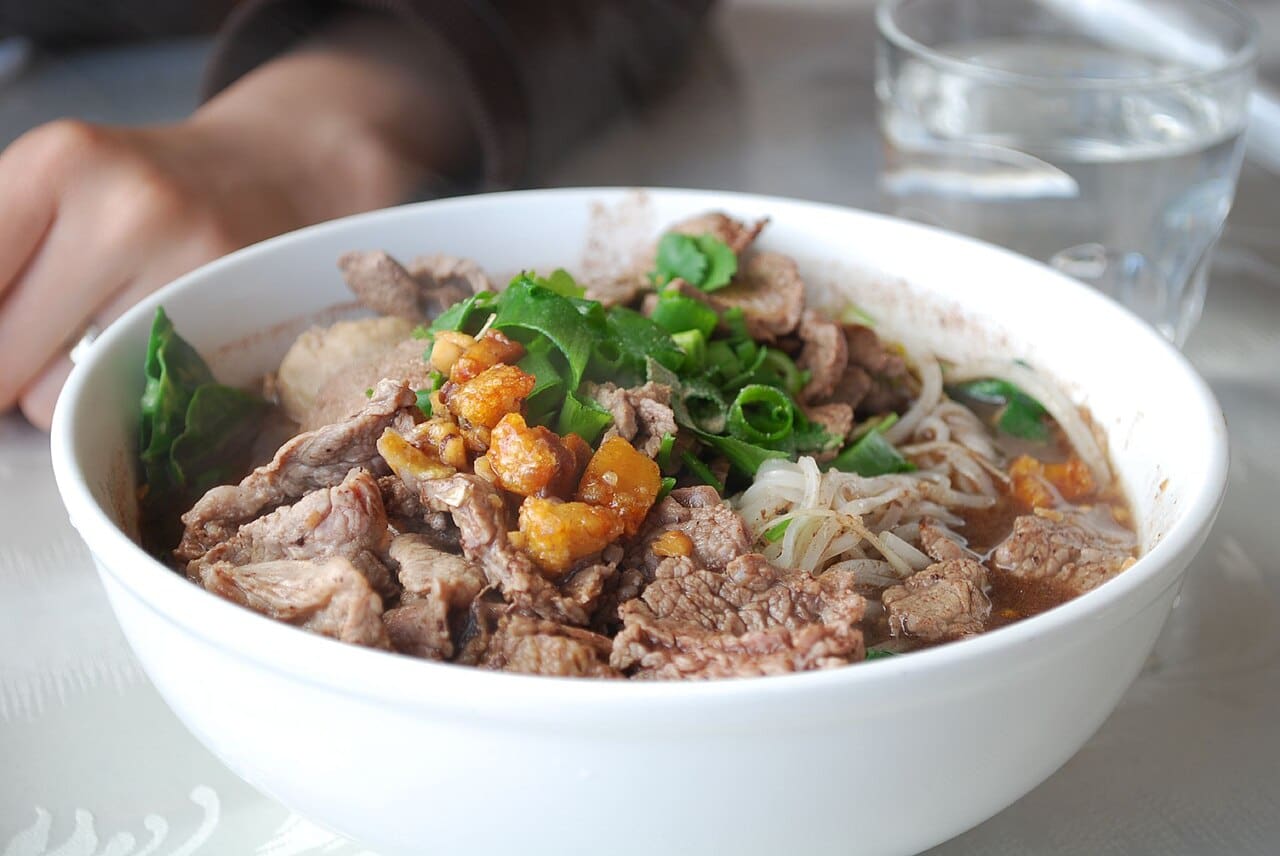 | 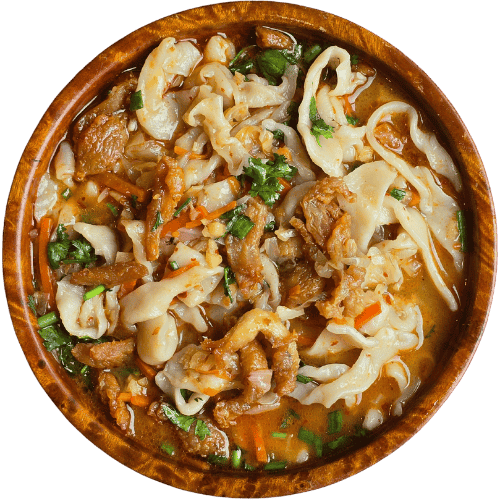 |
| Style | Small bowl, intense dark broth | Large bowl, clear broth |
| Hero flavours | Star anise, cinnamon, soy, pork blood, herbs | Garlic, ginger, beef or yak stock, fresh radish |
| Why you order it | You want something punchy in three bites | You want something warming and slow |
| Where | Any Bangkok street stall | Bhutan Kitchen menu: Bathub |
Both are noodle-in-broth comfort foods – but the heat register and the broth style are wildly different. Thai boat noodles are tiny by design: vendors sold them on boats so you’d down several bowls in one sitting. Bhutanese Bathub is a sit-down, eat-slow dish with hand-pulled noodles and small dice of seasonal vegetables.
2. Pad Krapow Moo (Thai Basil Pork) vs Sikam Phaksha Paa (Bhutanese Pork with Dried Radish)
| Pad Krapow Moo | Sikam Phaksha Paa | |
|---|---|---|
| Photo | 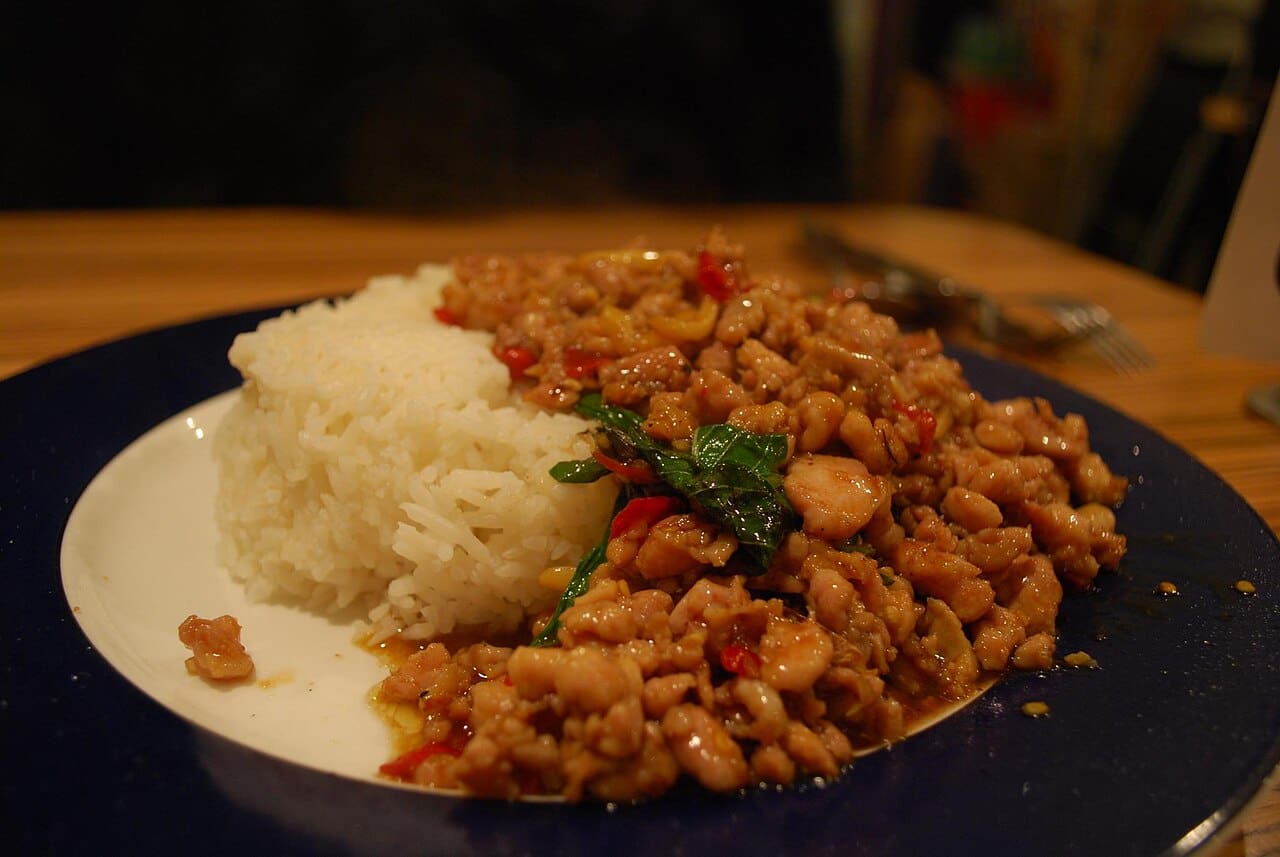 | 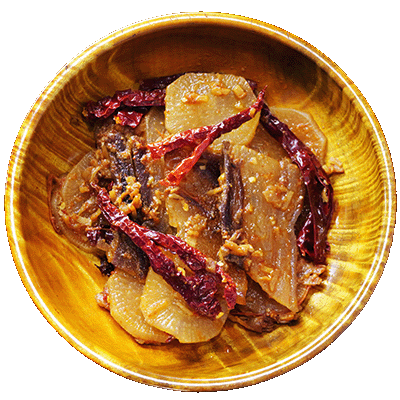 |
| Heat source | Bird’s eye chilies pounded with garlic | Local sikam chili flakes + whole red chilies |
| Centre of the dish | Holy basil and fish sauce | Dried radish (sikam) – the umami engine |
| Served over | Jasmine rice + crispy egg | Red rice, no egg |
| Where | Every Bangkok street stall | Bhutan Kitchen menu: Sikam Phaksha Paa |
Pad Krapow is the dish most Bangkok office workers eat for lunch. Sikam Phaksha Paa is its closest cousin, also a wok-tossed pork dish, but it’s driven by dried radish, not basil, and the chili grade is dialled up from “season the dish” to “the dish is chili.” Read the Sikam Phaksha Paa page
3. Pad Thai vs Jangbuli (Bhutanese Stir-Fried Noodles)
| Pad Thai | Jangbuli | |
|---|---|---|
| Photo | 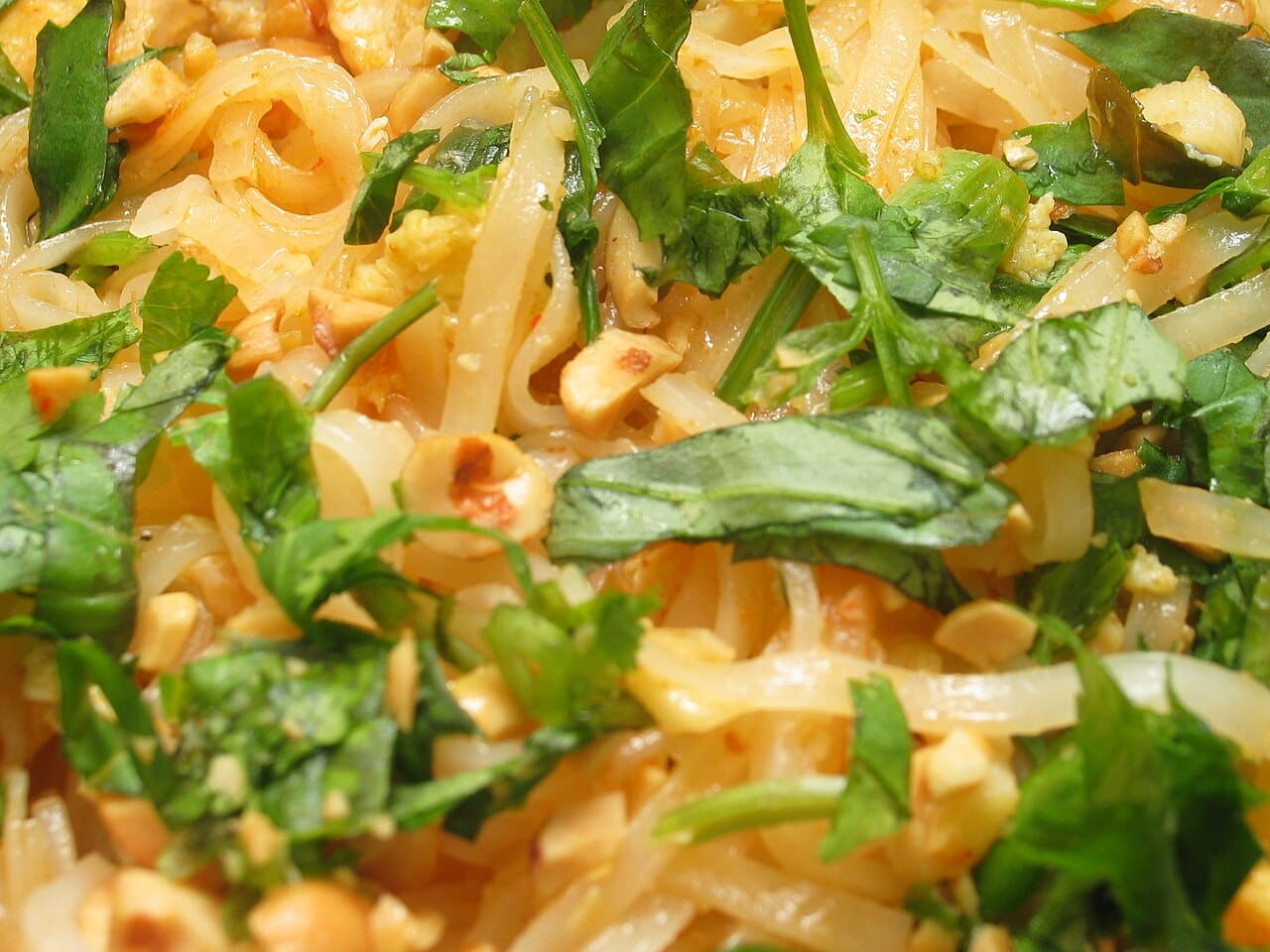 | 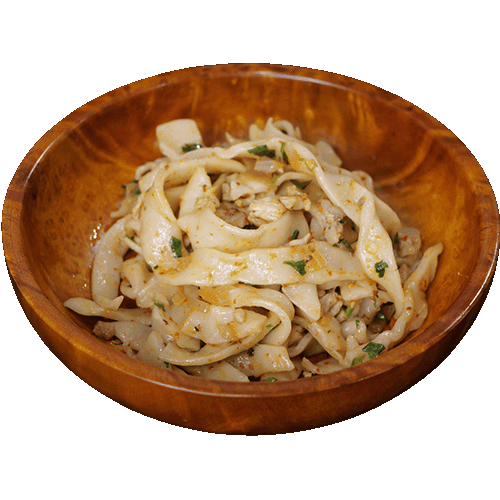 |
| Flavour base | Tamarind + palm sugar + fish sauce | Tomato + egg + chili flakes |
| Hero textural note | Crushed peanuts, bean sprouts | Crispy fried egg, fresh onion |
| Heat level | Mild-to-medium | Medium-to-fiery |
| Where | Any street stall, pad thai is Thailand’s signature | Bhutan Kitchen menu: Jangbuli |
If Pad Thai is Thailand’s “introduce yourself” dish, Jangbuli is Bhutan Kitchen’s “introduce yourself” dish. They’re both stir-fried rice noodles, but they taste nothing alike. Pad Thai balances sweet, sour, and salty. Jangbuli goes hot-and-savoury with a tomato base. The Jangbuli page has the full recipe and ordering notes.
4. Gai Pad Med Mamuang (Chicken Cashew) vs Bhutanese Chilli Chicken
| Gai Pad Med Mamuang | Bhutanese Chilli Chicken | |
|---|---|---|
| Photo | 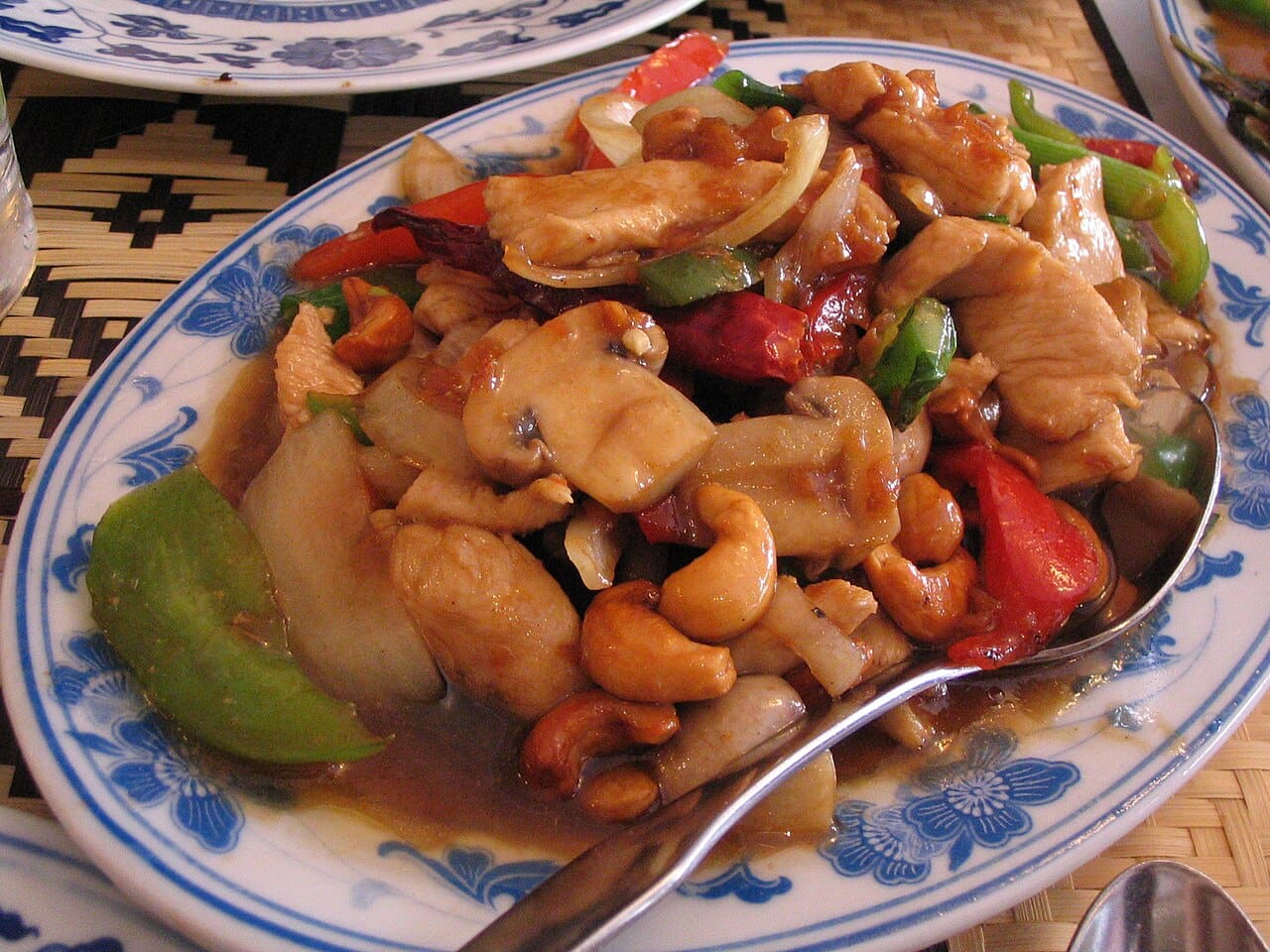 | 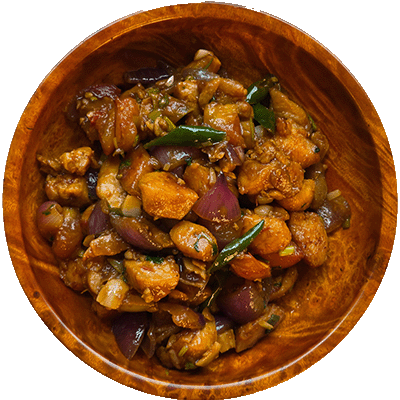 |
| Hero crunch | Cashews | Dried chilies and onions |
| Heat register | Sweet-spicy | Spicy (Green Chillies) |
| Sweetness | Sugar + oyster sauce | Some from Tomato |
| Where | Any Thai restaurant with a “house specials” page | Bhutan Kitchen menu: Bhutanese Chilli Chicken |
This is the matchup that surprises people most. The dish you remember as “a stir-fry with nuts and dried chilies” is exactly what Bhutanese food does too with Chili Chicken. It is more dry, but gives you similar flavours on the palette and is very popular for first timers. If you order one dish at Bhutan Kitchen that has no Thai analogue at all, this is it.
5. Thai Dumplings (Khai Jeeb / Giew) vs Bhutanese Momos
| Thai steamed dumplings (khanom jeeb) | Bhutanese Momos | |
|---|---|---|
| Photo | 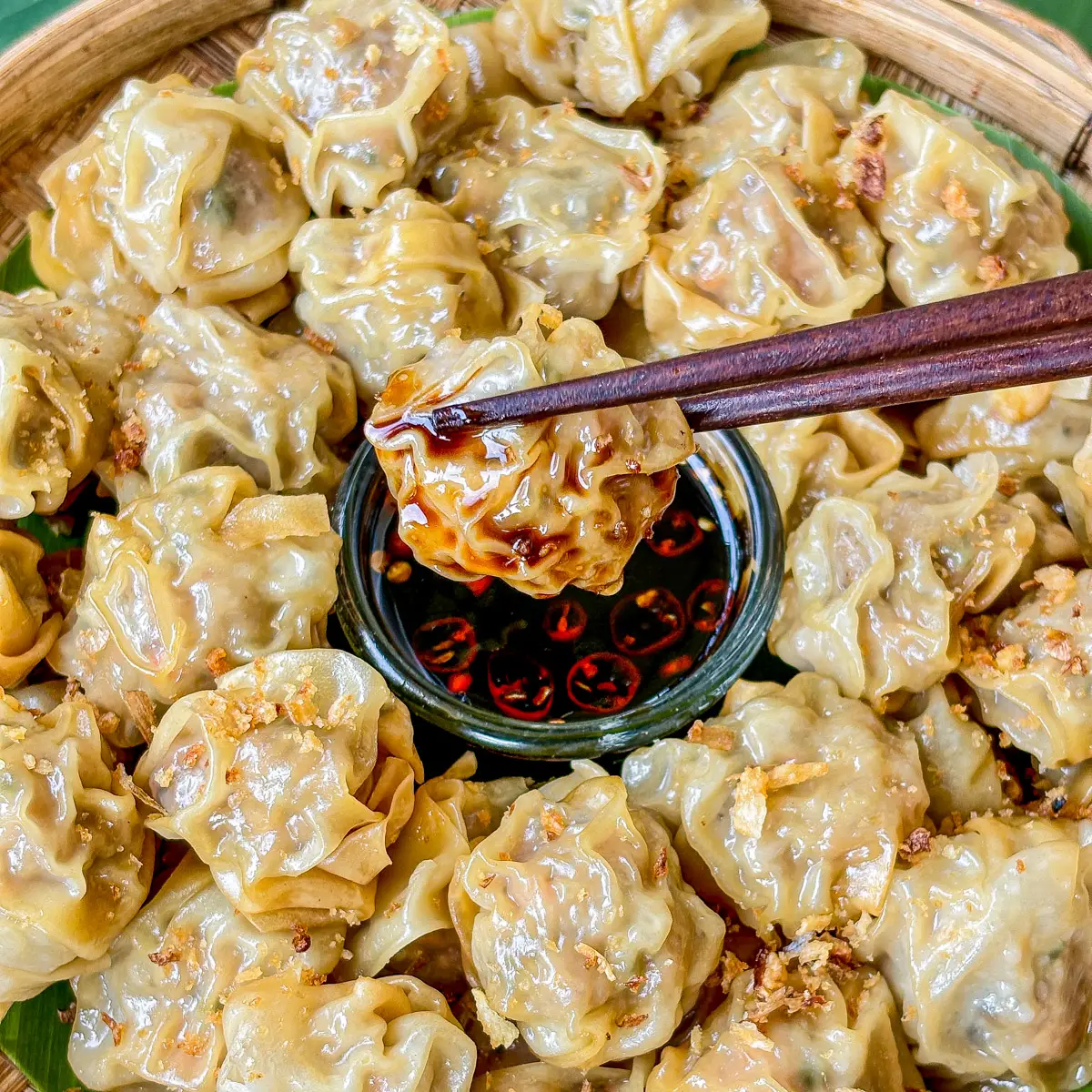 | 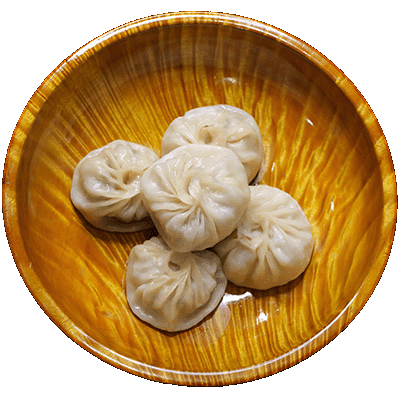 |
| Wrapper | Thin, translucent wheat | Thicker wheat or white-flour wrap |
| Filling | Pork, shrimp, chive, peanut | Beef, chicken, pork, cheese, or veg |
| Dipping sauce | Sweet chili sauce or soy + vinegar | Ezay – chunky chili–tomato–cheese relish |
| Where | Bangkok dim-sum carts | Bhutan Kitchen momos menu |
Momos are Bhutan’s national comfort food and they’re dumplings in the same wide family as Thai khanom jeeb. The wrapper, the dipping sauce, and the filling are all different. Bhutanese momos are slightly thicker, chewier, and served with the chunky chili-tomato-onion relish that Bhutanese call ezay. If you’ve only ever had one kind of dumpling, this is the one to try next.
6. National Dish Showdown: Som Tam (Green Papaya Salad) vs Red Chilli Ema Datshi
| Som Tam (Thai national dish) | Ema Datshi (Bhutanese national dish) | |
|---|---|---|
| Photo | 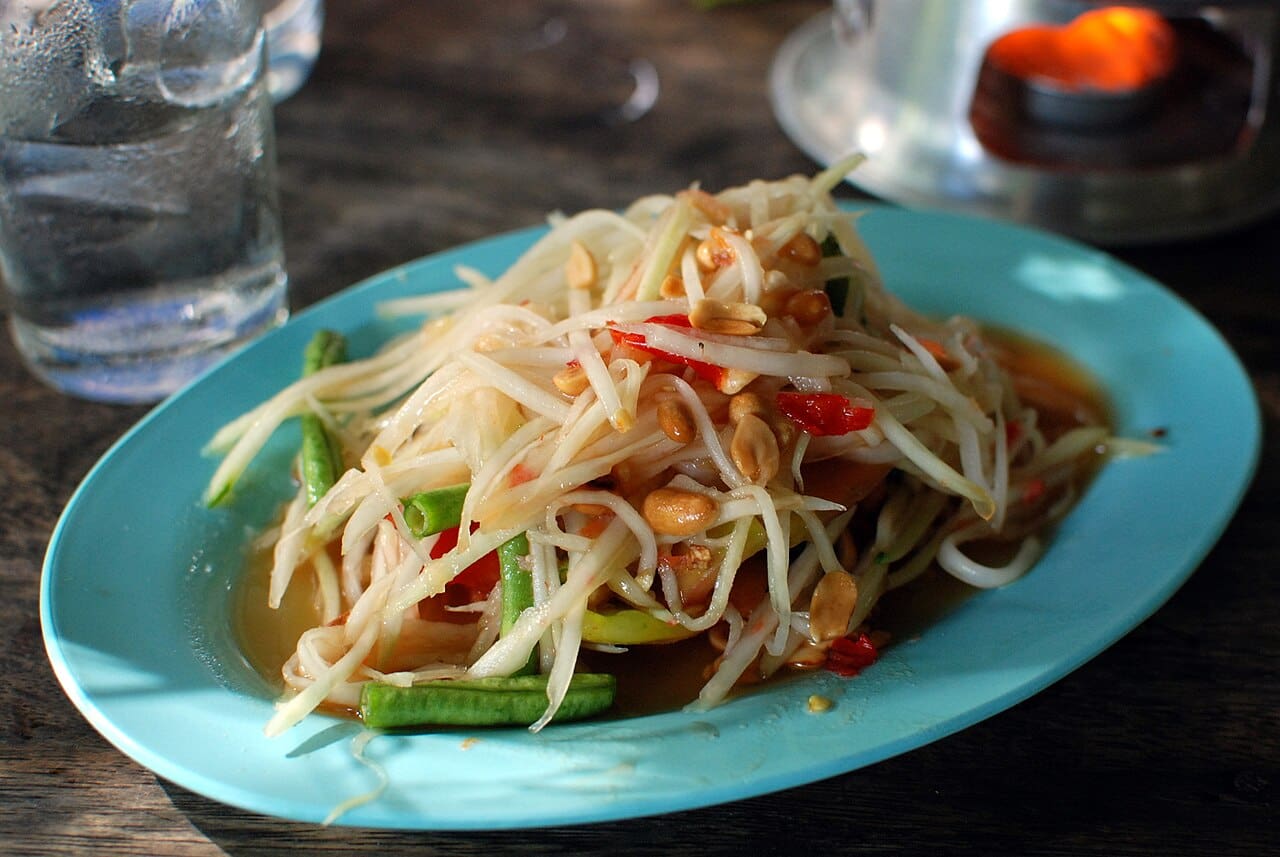 | 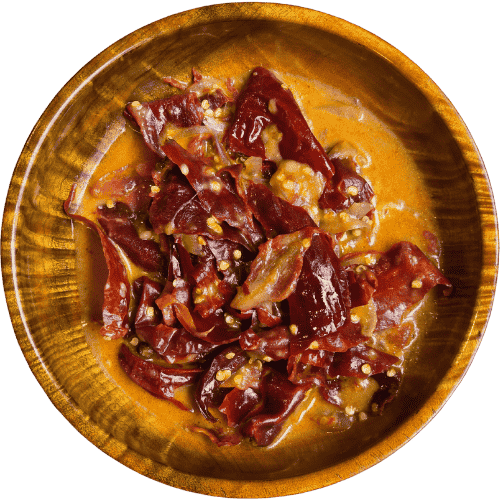 |
| Hero ingredient | Raw green papaya | Whole red chilies |
| Creaminess | None — it should be light and juicy | From melting datshi cheese |
| Flavour stack | Sweet-sour-salty-spicy with funky fish sauce | Chili + dairy + tomato + onion |
| Heat register | Bright, sharp, hot | Heavy, sustained, hot |
| Where | Every market stall in Bangkok | Bhutan Kitchen: Red Chilli Ema Datshi |
These two dishes could not be more different, which is why they belong together. Som Tam is the iconic Thai balance: crisp, raw, four-flavours-in-your-mouth, a fork-thrust in under five minutes. Ema Datshi (ཨེ་མ་དར་ཚིལ་), literally “chili cheese,” is the iconic Bhutanese statement: chili as a vegetable, dairy-rich, slowly melted, eaten with red rice. Both are national. Both should be ordered at least once. (More on Ema Datshi – a deep-dive post on our menu blog.)
After the matchups: the bigger question
Walking through those six matchups you can see the two-axis pattern:
- Vertical axis – chili philosophy: Thai cooking chases prik wan prik (balanced heat). Bhutanese cooking chases ema (the chili leads).
- Horizontal axis – dairy: Thai food is essentially dairy-free. Bhutanese food centres on datshi cheese and butter.

If you like a dish in the top row of the matchups (Pad Thai, Pad Krapow, Som Tam – the lighter, brighter dishes), the bottom-row equivalents are where you’ll feel at home in Bhutanese food. If you like the bottom row on the Thai side (massaman, panang), you’ll love Bathub, Ema Datshi, and Shakam Paa.
Why Bhutanese food is so much harder to find in Bangkok
Thailand has 70 million people, 50,000+ Thai restaurants in Bangkok alone, an unbroken cook-to-market supply chain, and a tourism economy built around Thai food. The cold-chain, the fish sauce factories, the coconut groves, the regional cuisines, the cookbook canon, the universities teaching Thai cuisine – all of it has been building for centuries.
Bhutan is less than 800,000 people, almost no commercial food export, no industrial dairy, and a diaspora that scattered quietly. The cooks who learned to make ema datshi from their grandmothers in Thimphu or Paro are scattered, the ingredients are nearly impossible to source in a Bangkok wholesale market, and there are maybe a handful of restaurants in the city that take the trouble to do it properly.
This is why Bhutan Kitchen exists, to help bridge the gap between these two wonderful countries.
What to order at Bhutan Kitchen on your first visit
Here are some great options for a first try if you prefer a little less spice:
- Momos – steamed dumplings, beef or cheese. The friendliest entry. Familiar shape, unfamiliar sauce.
- Red Chilli Ema Datshi, mild – start at half the heat we usually serve. The cheese carries the dish even when the chili holds back.
- Bhutanese Chilli Chicken – if you’ve ordered Thai cashew chicken a hundred times, this is the closest cousin with a totally different twist.
- Suja – one cup, hot, salted butter tea. It will taste strange for exactly three sips and then completely normal. That’s the butter talking.
If you eat with us before or after a Thai dinner in the same week, you’ll see the cuisine pattern your tongue has been hinting at.