Bhutan is a constitutional monarchy in the Eastern Himalayas, bordered by China to the north and India to the south. With a population of approximately 727,000 people spread across 38,394 square kilometers, Bhutan is the only country in the world that measures its success through Gross National Happiness rather than Gross Domestic Product. Bhutan’s government charges visitors a $100 per day Sustainable Development Fee (reduced to this until Aug 27), making it one of the most exclusive travel destinations on Earth. (Note this fee includes food, board and a guide)
This guide explains what makes Bhutan unique and how to experience its key attractions. The article covers Tiger’s Nest monastery, Punakha Dzong, Bhutanese cuisine including ema datshi, and practical information for planning your visit.
What makes Bhutan Unique?
Bhutan stands out as a unique travel destination due to its pioneering Gross National Happiness (GNH) philosophy, which prioritizes citizen well-being over GDP, ensuring 72% forest cover and so maintains a carbon-negative status, the only nation worldwide (UNEP). High Sustainable Development Fees ($100/night) enforce low-volume tourism, delivering uncrowded immersion in Tiger’s Nest Monastery hikes, vibrant tshechu festivals, and pristine Himalayan valleys, fostering spiritual recharge amid authentic Buddhist culture without the commercialization plaguing neighbors like Nepal.
Key Bhutanese Attractions
- Tigers Nest – Landmark Bhutanese Monastery in cliff face
What Is the Tiger’s Nest?
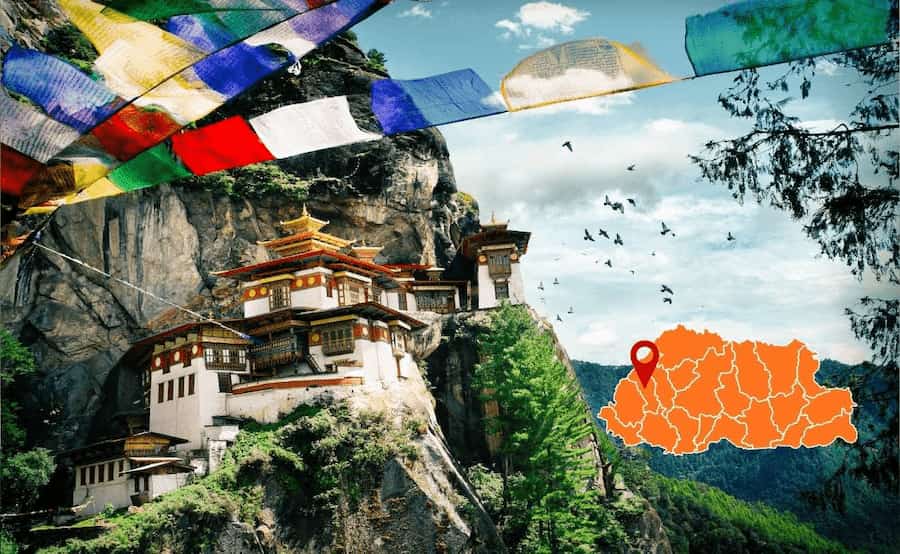
Tiger’s Nest (Paro Taktsang) is a Buddhist monastery complex built into a cliff face 3,120 meters above sea level in Bhutan’s Paro Valley. According to Bhutanese tradition, Guru Padmasambhava flew to this location from Tibet on the back of a tigress in the 8th century and meditated in a cave for three years. The monastery complex was constructed around this sacred cave in 1692 and has become the most iconic landmark in Bhutan.
Why Is Tiger’s Nest Important?
Tiger’s Nest represents the spiritual foundation of Bhutanese Buddhism. Guru Padmasambhava introduced Vajrayana Buddhism to Bhutan, and this site marks where he established the spiritual practices that continue to define Bhutanese culture today. The monastery houses multiple temples and shrines dedicated to the Guru’s eight manifestations.
The site draws over 50,000 visitors annually according to Bhutan’s Department of Tourism. Most visitors complete the trek to Tiger’s Nest as the centerpiece of their Bhutan trip.
How Difficult Is the Tiger’s Nest Trek?
The trek from the valley floor to Tiger’s Nest takes approximately 2 to 3 hours one way. The trail gains about 900 meters in elevation through pine forests covered in prayer flags. The path is well maintained with rest stops and a cafeteria at the halfway point.
Trekkers have three options for the ascent:
| Option | Duration | Difficulty | Best For |
| Full trek on foot | 2-3 hours | Moderate | Fit hikers |
| Pony ride + walk | 1.5 hours | Easy | Most visitors |
| Guide assistance | 2-3 hours | Moderate | First-time trekkers |
The final 700 meters of the trail involves steep stone steps that must be climbed on foot regardless of whether you use a pony for the first section.
What Should You Bring to Tiger’s Nest?
Visitors should pack the following items:
- Sturdy hiking boots with ankle support
- Water bottle (minimum 1 liter)
- Sunscreen and sunglasses
- Light jacket (temperatures drop at altitude)
- Snacks for energy
- Camera (photography allowed outside temples)
The Bhutan Tourism Council recommends starting the trek between 7:00 AM and 8:00 AM to avoid afternoon clouds that often obscure the monastery views.
- Dzongs
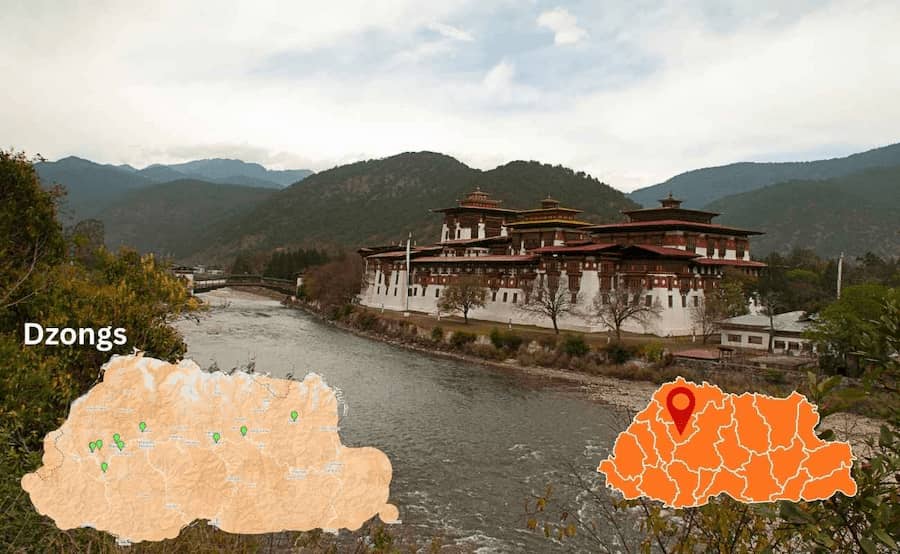
What Is a Dzong?
A dzong is a distinctive type of fortress architecture found only in Bhutan and Tibet. These massive structures combine military defense, religious worship, and government administration in a single complex. Dzongs feature thick whitewashed walls, central towers called utse, and courtyards that host religious festivals. Bhutan contains approximately 20 major dzongs, each serving as the administrative and religious center for its district.
How Do Dzongs Function in Bhutanese Society?
Dzongs operate as dual-purpose institutions. The secular wing houses district government offices, courtrooms, and administrative facilities. The religious wing contains monastic quarters, temples, and meditation spaces for Buddhist monks. This integration reflects Bhutan’s historical union of spiritual and temporal authority.
The Punakha Dzong exemplifies this dual function. It served as Bhutan’s capital from 1638 until 1955 and remains the winter residence of the Je Khenpo (Chief Abbot) and the Central Monastic Body according to official Bhutan government records.
What Is Punakha Dzong?
Punakha Dzong (formally named Pungthang Dechen Phodrang) is the second largest and second oldest dzong in Bhutan. Zhabdrung Ngawang Namgyal constructed it in 1637 at the confluence of the Pho Chhu (Male River) and Mo Chhu (Female River). The dzong sits at 1,200 meters elevation, giving it a subtropical climate that supports jacaranda trees blooming with mauve flowers each spring.
Key facts about Punakha Dzong:
- It has hosted the coronation of every Bhutanese king since 1907
- It contains sacred relics of the Drukpa Lineage of Tibetan Buddhism
- It appears on Bhutan’s Tentative List for UNESCO World Heritage Site inclusion
- It houses approximately 1,000 monks during the winter months
How Is Punakha Dzong Different from Other Dzongs?
Unlike dzongs in higher elevations, Punakha Dzong’s low altitude creates a unique environment. The warmer climate allows for gardens and flowering trees that cannot survive at Thimphu’s 2,300 meter elevation. The dzong’s location at the river confluence also made it strategically vital for controlling trade routes between Tibet and India.
- Dochula Pass
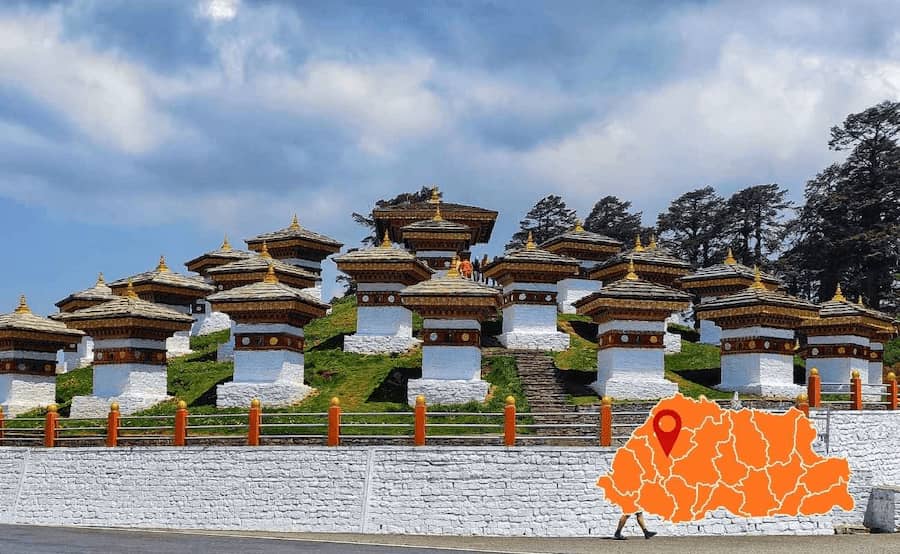
At 3,100 meters (10,200 feet) above sea level, Dochula Pass stands as one of Bhutan’s most breathtaking vantage points. This mountain pass, located just 30 kilometers from Thimphu on the road to Punakha, offers visitors an inspired experience. It is a place where the physical and spiritual realms converge against a backdrop of the world’s highest peaks in the Himalayas. Simply wonderful.
The 108 Druk Wangyal Chortens
The most striking feature of Dochula Pass is the collection of 108 whitewashed chortens (stupas) known as the Druk Wangyal Chortens. These religious monuments were constructed in 2004 under the initiative of Her Majesty the Queen Mother, Ashi Dorji Wangmo Wangchuck, to honor the Bhutanese soldiers who lost their lives in the December 2003 military operation against Assamese insurgents.
The number 108 holds profound significance in Bhutanese Buddhism. It represents the 108 human desires that must be overcome to achieve enlightenment. Walking among these chortens, visitors often report a sense of profound peace and I myself found it very touching. Each stupa contains sacred relics and prayers, and together they form one of the most photographed landmarks in the kingdom.
The View: Himalayan Panorama
On clear days, Dochula Pass offers what many consider the finest panoramic views of the Bhutanese Himalayas. The snow-capped peaks of the Gangkar Puensum massif dominate the horizon, which is the highest unclimbed mountain in the world at 7,570 meters. On exceptionally clear mornings, visitors can see a chain of peaks stretching across the northern border including Masanggang, Tsendagang, Terigang, Jejegangphugang, Kangphugang, and Zongaphugang.
The best time for mountain viewing is during the dry season months of October through March, when the monsoon clouds have dispersed and the air is crisp and clear. Sunrise visits are particularly rewarding, as the first light of day illuminates the snow-capped peaks in shades of pink and gold, a real spectacle that has moved countless visitors to tears.
Druk Wangyal Lhakhang
In addition to the chortens, the pass is home to the Druk Wangyal Lhakhang, a temple built in honor of the Fourth Druk Gyalpo, Jigme Singye Wangchuck. The temple’s architecture blends traditional Bhutanese design with modern elements, and its interior walls feature elaborate murals depicting the history of Bhutan’s kings and significant events in the nation’s history.
Practical Information about Dochula Pass
Dochula Pass is accessible year-round, though winter snows may occasionally make the road challenging. The pass lies directly on the main highway between Thimphu and Punakha, making it an easy stop for travelers moving between these two important Bhutanese cities. Most tour operators include Dochula as a standard stop on the Thimphu-Punakha route.
Facilities at the pass include a small café serving traditional Bhutanese tea and snacks offering a welcome respite from the sharp mountain chill. The nearby Dochula Resort offers luxury accommodation for those wishing to experience sunrise and sunset at this remarkable location.
Dochula Pass delivers an experience that lingers in the memory long after leaving Bhutan.
Visitors should plan to spend at least an hour at the pass, allowing time to walk among the chortens, visit the temple, and simply absorb the majesty of the surrounding peaks. Warm clothing is essential year-round, as temperatures at this elevation can drop significantly even during summer months.
- GNH – Gross National Happiness
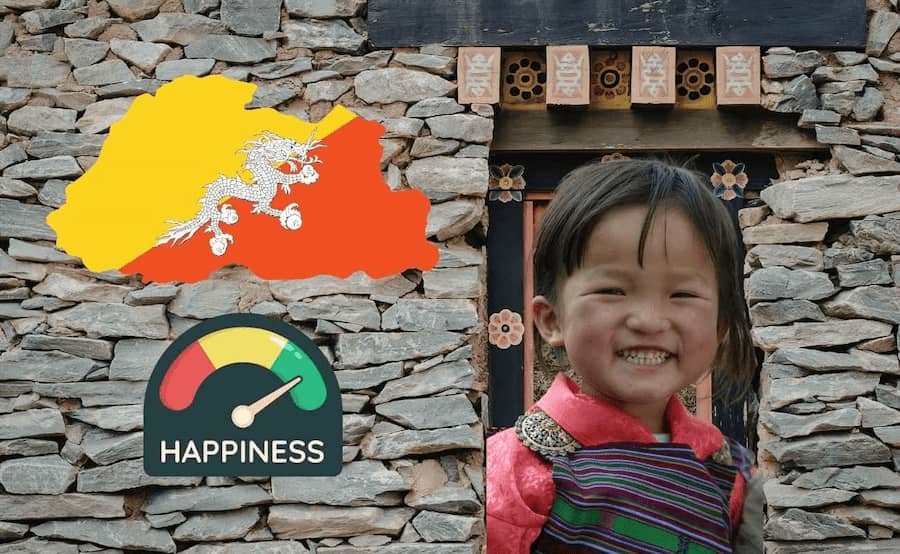
What Is Gross National Happiness?
Gross National Happiness (GNH) is a development philosophy pioneered by Bhutan that measures national progress through collective well-being rather than economic output alone. The Fourth King of Bhutan, Jigme Singye Wangchuck, declared in 1972 that “Gross National Happiness is more important than Gross Domestic Product.” Bhutan’s 2008 Constitution formally adopted GNH as the goal of government.
What Are the Four Pillars of GNH?
GNH rests on four foundational pillars according to the Centre for Bhutan Studies:
- Sustainable and equitable socio-economic development
- Conservation of the environment
- Preservation and promotion of culture
- Good governance
These pillars ensure that development in Bhutan considers environmental, cultural, and governance factors alongside economic growth.
How Is GNH Measured?
The GNH Index tracks nine specific domains:
| Domain | What It Measures |
| Psychological well-being | Mental health, life satisfaction |
| Health | Access to healthcare, life expectancy |
| Education | Literacy, schooling quality |
| Time use | Work-life balance, sleep quality |
| Cultural diversity | Language preservation, traditions |
| Good governance | Democracy, rule of law |
| Community vitality | Social support, family bonds |
| Ecological resilience | Environmental health, biodiversity |
| Living standards | Income, housing, assets |
Bhutan conducts comprehensive GNH surveys every five years. The 2022 survey found that 47.9% of Bhutanese are “extensively happy” or “deeply happy” according to official government data.
How Is GNH Different from GDP?
GDP measures economic activity through production and consumption. GNH measures quality of life through well-being indicators. A country can have high GDP but low GNH if economic growth comes at the cost of environmental destruction, cultural erosion, or social inequality.
Bhutan’s approach has gained international recognition. The United Nations General Assembly passed Resolution 65/309 in 2011, urging member nations to follow Bhutan’s example in measuring happiness. The UN subsequently declared March 20 as the International Day of Happiness.
- Bhutanese Cuisine
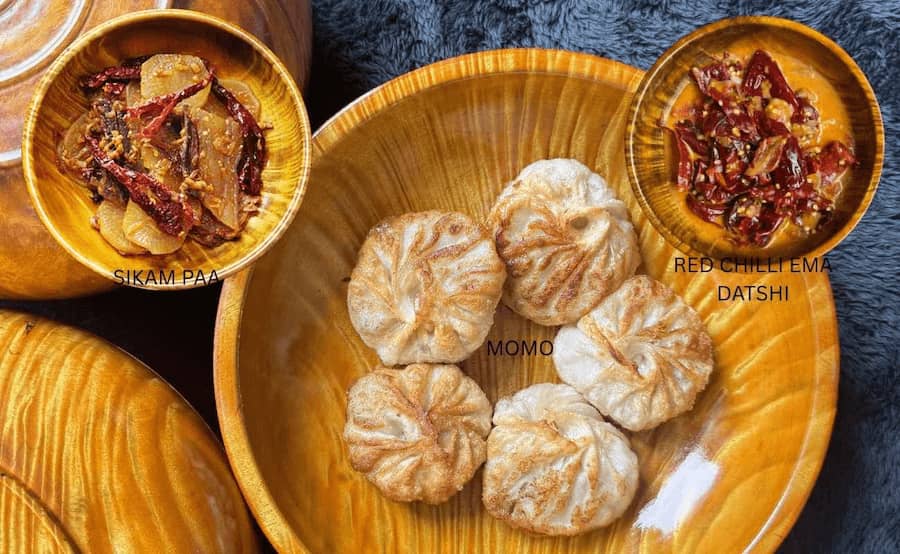
What Is Bhutanese Cuisine?
Bhutanese cuisine consists of dishes developed in the Himalayan region using locally available ingredients. The cuisine emphasizes rice (particularly Bhutanese red rice), dairy products from yaks and cows, meat (pork, beef, chicken), and large quantities of chili peppers. Bhutanese cooks use few complex spice blends, relying instead on the freshness and quality of individual ingredients.
What Is Ema Datshi?
Ema datshi is a stew made from chili peppers and cheese that serves as Bhutan’s national dish, that comes with red or green chillies. The name combines “ema” (chili) and “datshi” (cheese). Bhutanese households eat ema datshi daily, typically served with red rice. The dish appears at every meal including breakfast.
Variations of ema datshi include:
- Kewa datshi (potatoes and cheese)
- Shamu datshi (mushrooms and cheese)
- Semchum datshi (beans and cheese)
- Gondo datshi (scrambled eggs and cheese)
- Shakam Datshi (sun-dried beef and cheese)
The cheese used is typically a fresh cottage cheese called datshi, made from cow’s milk. Eastern Bhutan produces a mature version called zoetay that has a strong smell and greenish color.
How Spicy Is Bhutanese Food?
Bhutanese cuisine ranks among the spiciest in the world. Chillies serve as a vegetable, not just as a seasoning. Dried chillies appear as side dishes. Fresh green chillies are served raw alongside meals. The Bhutanese saying states: “If it does not have chili, it is not food.”
Restaurants catering to tourists can and do reduce spice levels, but requesting “no chili” may confuse staff in a dish that has chilli at its core. Visitors should prepare for significant heat even in “mild” versions.
What Other Foods Should You Try in Bhutan?
Essential Bhutanese dishes include:
- Momos (steamed dumplings with meat or vegetable filling)
- Red rice (nutty, slightly chewy Bhutanese staple)
- Phaksha paa (fatty dried pork with chillies and vegetables)
- Jasha maru (spicy chicken stew)
- Suja (butter tea made with tea leaves, salt, and butter)
- Ara with Shakam (local rice wine with dried beef)
- Chhurpi (hardened yak cheese)
- Jangbuli (Flat noodles from Bumthang region)
How Does Bhutanese Food Differ from Tibetan and Nepalese Cuisine?
While Bhutanese cuisine shares Himalayan roots with Tibetan and Nepalese food, distinct differences exist, let me break it down:
| Feature | Bhutanese | Tibetan | Nepalese |
| Spice level | Extremely high | Mild | Moderate |
| Cheese use | Central to dishes | Limited | Limited |
| National dish | Ema datshi (chili cheese) | Momos | Dal bhat |
| Staple grain | Red rice | Barley, wheat | Rice, lentils |
| Tea style | Butter tea (salty) | Butter tea | Milk tea (sweet) |
Bhutanese cuisine stands apart for its embrace of dairy combined with intense spice levels.
Where Can You Find Bhutanese Food in Bangkok?
Bhutan Kitchen in Taka Town (sukhumvit soi 39/petchaburi soi 38/1) offer ema datshi prepared with imported Bhutanese cheese, red rice sourced from Bhutan, imported spices and vegetables, traditional momos, and suja butter tea to name just a few.
With Chefs who honed their craft in 5-star establishments in Thimphu, you can rest assured you are getting a true bhutanese experience.
Why Experience Bhutanese Cuisine?
Bhutanese food offers insight into the kingdom’s culture that sightseeing alone cannot provide. The cuisine reflects climate adaptation (preservation techniques for harsh winters), Buddhist values (wholesome ingredients, respect for life with lots for vegetarians), and environmental connection (organic farming, wild foraged ingredients).
- Tshechus – Bhutanese Festivals
What Are Bhutanese Festivals?
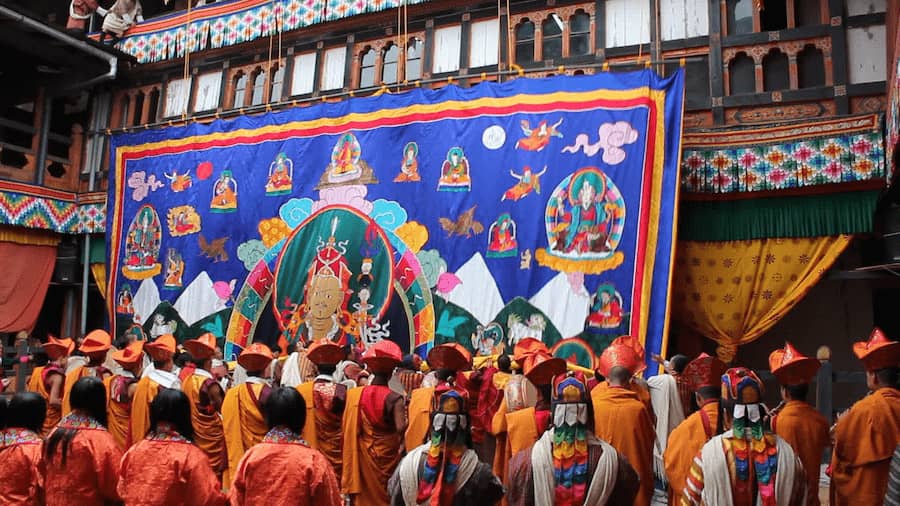
Bhutanese festivals called tshechus are annual religious events held at dzongs and monasteries throughout the kingdom. These festivals feature masked dances performed by monks and laypeople, religious ceremonies, and community gatherings. Tshechus have remained largely unchanged for centuries and offer visitors the most immersive cultural experiences available in Bhutan.
What Happens at a Tshechu?
Tshechus last three to five days and include several key components:
Masked Dances (Cham): Performers wear elaborate silk costumes and wooden masks depicting deities, demons, and animals. Each dance tells stories from Buddhist mythology and conveys moral lessons about good triumphing over evil.
Thongdrel Ceremonies: On the final day, massive religious tapestries (thongdrels) depicting Guru Padmasambhava are unfurled at dawn. Bhutanese believe that seeing a thongdrel cleanses sins and brings blessings.
Community Celebration: Families pack elaborate picnic lunches. Children play traditional games. The atmosphere combines religious reverence with joyful socializing.
When Are the Major Tshechus?
| Festival | Location | Timing | Notable Features |
| Paro Tshechu | Paro Dzong | March or April | Thongdrel unveiling, largest crowds |
| Thimphu Tshechu | Tashichho Dzong | September or October | Royal family attendance |
| Punakha Tshechu | Punakha Dzong | February or March | Commemorates Bhutanese victory over Tibet |
| Jambay Lhakhang Drup | Bumthang | October | Sacred fire ceremony |
| Black Necked Crane Festival | Phobjikha Valley | November 11 | Wildlife conservation focus |
How Should You Plan Around Tshechus?
Tshechus require advance planning:
- Book accommodations 6 to 12 months in advance
- Popular dzongs reach capacity during major festivals
- Tour operators can secure festival permits and prime viewing spots
- Bring warm clothing for early morning thongdrel ceremonies
- Photography is allowed but flash is prohibited during dances
How Much Does Bhutan Cost to Visit?
Bhutan requires visitors to pay a Sustainable Development Fee (SDF) of $100 per person per day. This fee funds free healthcare, education, and environmental conservation for Bhutanese citizens. Additional costs include accommodation, meals, transportation, and guide services arranged through licensed tour operators.
What Does the $100 SDF Cover?
The Sustainable Development Fee directly supports:
- Free universal healthcare for all Bhutanese citizens
- Education initiatives throughout the kingdom
- Environmental conservation programs
- Cultural preservation efforts
- Infrastructure development in rural areas
Think of the SDF as a contribution to Bhutan’s well-being rather than a tourist tax. This fee exemplifies the GNH philosophy in practice.
What Is the Total Cost of a Bhutan Trip?
Beyond the $100/day SDF, visitors should budget:
| Expense | Low Budget | Mid Range | Luxury |
| Accommodation | $60-80/night | $150-250/night | $400+/night |
| Meals | $20-30/day | $40-60/day | $80-120/day |
| Guide | Included | Included | Included |
| Transport | Included | Included | Private vehicle |
| Daily Total | $180-210 | $290-410 | $580+ |
Most tour operators offer packages ranging from $200 to $400 per day including SDF, accommodation, meals, transport, and guide services.
How Does Bhutan’s Cost Compare to Other Himalayan Destinations?
| Destination | Daily Cost | Tourism Model | Crowds |
| Bhutan | $200–400 | High value, low volume | Minimal |
| Nepal | $50–150 | Mass tourism | High |
| Tibet | $100–200 | Restricted access | Moderate |
| Northern India | $30–100 | Mass tourism | High |
Bhutan’s exclusive model ensures uncrowded attractions and preserved culture but comes at a premium price.
When Is the Best Time to Visit Bhutan?
The best time to visit Bhutan depends on your priorities. Spring (March to May) offers blooming rhododendrons and the Paro Tshechu. Autumn (September to November) provides clear mountain views and the Thimphu Tshechu. Winter (December to February) brings fewer tourists and lower prices. Summer (June to August) sees monsoon rains but lush green landscapes.
What Is Each Season Like?
Spring (March to May):
- Temperatures: 10-25 degrees Celsius
- Weather: Dry, occasional showers
- Highlights: Rhododendron forests in bloom, Paro Tshechu, comfortable trekking
- Crowds: High
Summer (June to August):
- Temperatures: 15-30 degrees Celsius
- Weather: Monsoon rains, high humidity
- Highlights: Lush green valleys, fewer tourists, lower prices
- Crowds: Low
Autumn (September to November):
- Temperatures: 10-25 degrees Celsius
- Weather: Clear skies, minimal rain
- Highlights: Best mountain views, Thimphu Tshechu, ideal photography
- Crowds: Highest
Winter (December to February):
- Temperatures: -5 to 15 degrees Celsius
- Weather: Cold, dry, clear skies
- Highlights: Black Necked Crane Festival, snow-capped peaks, lowest prices
- Crowds: Lowest
How Does Altitude Affect Your Visit?
Bhutan ranges from subtropical valleys at 150 meters to Himalayan peaks exceeding 7,000 meters. Most tourist destinations sit between 2,000 and 3,500 meters. Tiger’s Nest is at 3,120 meters, high enough to cause altitude sensitivity.
Symptoms of altitude sickness include headache, nausea, dizziness, and shortness of breath. Prevention measures include:
- Ascending gradually
- Drinking plenty of water
- Avoiding alcohol for the first 48 hours
- Resting if symptoms appear
- Informing your guide immediately if symptoms worsen
FAQ: Common Questions About Bhutan
What Is Bhutan Known For?
Bhutan is known for being the only carbon-negative country in the world, pioneering Gross National Happiness as a development metric, preserving traditional Buddhist culture, and requiring a $100 per day Sustainable Development Fee for tourists. The Tiger’s Nest monastery is its most photographed landmark.
Is Bhutan Safe for Tourists?
Bhutan is extremely safe with virtually no violent crime against tourists according to the US State Department and UK Foreign Office travel advisories. The main risks are altitude sickness and road conditions on mountain passes. Medical facilities exist in major towns but may be limited in remote areas.
What Language Do They Speak in Bhutan?
Dzongkha is the official language of Bhutan. English is widely spoken in tourist areas, hotels, and government offices. Many Bhutanese also speak Nepali and various regional dialects. Signs and official documents appear in both Dzongkha and English.
Can You Travel Independently in Bhutan?
Since 2022, visitors from certain countries can arrange their own accommodations and transport without booking through a tour operator. However, most travelers still use licensed tour operators for convenience. The $100 per day SDF applies regardless of booking method.
What Currency Does Bhutan Use?
The Bhutanese Ngultrum (BTN) is the official currency. The Indian Rupee is also accepted throughout Bhutan. Major hotels and shops in Thimphu and Paro accept credit cards, but cash is essential in rural areas. ATMs exist in major towns but can be unreliable.
What Is the Food Like in Bhutan?
Bhutanese cuisine is extremely spicy, featuring chili peppers as a main ingredient rather than just a seasoning. The national dish ema datshi consists of chilies and cheese. Rice, particularly Bhutanese red rice, accompanies most meals. Momos (dumplings), dried pork, and butter tea are also common.
Do You Need a Visa for Bhutan?
Most visitors require a visa arranged through a licensed Bhutanese tour operator. Indian nationals do not require a visa. The visa application process takes 7 to 10 working days and requires a passport valid for at least six months, passport photos, and proof of SDF payment.
How Do You Get to Bhutan?
Most visitors fly into Paro International Airport on Druk Air or Bhutan Airlines. The airport sits 2,200 meters above sea level and requires pilots to navigate through mountain valleys. Overland entry is possible from India through Phuentsholing in the south and Samdrup Jongkhar in the east.
What Should You Pack for Bhutan?
Pack layers for varying temperatures, sturdy hiking boots for Tiger’s Nest, modest clothing for temple visits (covered shoulders and knees), warm jacket for high-altitude areas, sunscreen, and any necessary medications. Formal dress is required for dzong visits.
Is Bhutan Worth the Cost?
Whether Bhutan is worth the cost depends on your travel priorities. Bhutan offers uncrowded attractions, authentic cultural experiences, pristine environments, and a unique development model. The cost is significantly higher than neighboring Nepal or India but includes guaranteed exclusivity and preserved culture.
What Is Not Allowed in Bhutan?
Bhutan prohibits:
Photography inside most temples
Tobacco sales (personal imports allowed with 200% tax)
Plastic bags in many areas
Mountaineering on peaks over 6,000 meters (spiritual respect)
Independent trekking without guides
How Is Bhutan Different from Nepal?
Bhutan and Nepal share Himalayan geography and Buddhist heritage but differ significantly:
| Aspect | Bhutan | Nepal |
| Tourism model | High value, low volume ($100/day fee) | Mass tourism |
| Development focus | Gross National Happiness | Economic growth |
| Forest cover | ~70%+ (around 70–75% in recent data) | ~40–47% (around 42–46% latest) |
| Population | ~800,000 (approx. 2025–2026 estimates) | ~29–30 million |
| Culture | Preserved traditional | More globalized |
| Trekking | Guide required | Independent allowed |